Commentary on the Four Gospel Books
The Gospel of the Lord Jesus Christ
G125 Paying Taxes to Caesar
Matthew 22:15-22; Mark 12:13-17; Luke 20:20-26
Download PDF:
https://od.lk/f/MV8zNTcyNDYyMTFf
https://od.lk/fl/MV8xODI0MzMzNl8
Please share this website with all your friends and family members. Thank you, and God bless.
All Scriptures quoted in this article are from the New King James Version (NKJV), unless otherwise noted (https://www.biblestudytools.com/nkjv/).
Matthew 22:15-22
15 Then the Pharisees went and plotted how they might entangle Him in His talk.
16 And they sent to Him their disciples with the Herodians, saying, “Teacher, we know that You are true, and teach the way of *God in truth; nor do You care about anyone, for You do not regard the person of men.
17 Tell us, therefore, what do You think? Is it lawful to pay taxes to Caesar, or not?”
18 But Jesus perceived their wickedness, and said, “Why do you test Me, you hypocrites?
19 Show Me the tax money.” So they brought Him a denarius.
20 And He said to them, “Whose image and inscription is this?”
21 They said to Him, “Caesar’s.” And He said to them, “Render therefore to Caesar the things that are Caesar’s, and to *God the things that are *God’s.”
22 When they had heard these words, they marveled, and left Him and went their way.
Mark 12:13-17
13 Then they sent to Him some of the Pharisees and the Herodians, to catch Him in His words.
14 When they had come, they said to Him, “Teacher, we know that You are true, and care about no one; for You do not regard the person of men, but teach the way of *God in truth. Is it lawful to pay taxes to Caesar, or not?
15 Shall we pay, or shall we not pay?” But He, knowing their hypocrisy, said to them, “Why do you test Me? Bring Me a denarius that I may see it.”
16 So they brought it. And He said to them, “Whose image and inscription is this?” They said to Him, “Caesar’s.”
17 And Jesus answered and said to them, “Render to Caesar the things that are Caesar’s, and to *God the things that are *God’s.” And they marveled at Him.
Luke 20:20-26
20 So they watched Him, and sent spies who pretended to be righteous, that they might seize on His words, in order to deliver Him to the power and the authority of the governor.
21 Then they asked Him, saying, “Teacher, we know that You say and teach rightly, and You do not show personal favoritism, but teach the way of **God in truth:
22 Is it lawful for us to pay taxes to Caesar or not?”
23 But He perceived their craftiness, and said to them, “Why do you test Me?
24 Show Me a denarius. Whose image and inscription does it have?” They answered and said, “Caesar’s.”
25 And He said to them, “Render therefore to Caesar the things that are Caesar’s, and to *God the things that are *God’s.”
26 But they could not catch Him in His words in the presence of the people. And they marveled at His answer and kept silent.
In this lesson, we will study how the Jewish religious leadership plotted to trap the Lord Jesus in order to accuse Him of opposing the Roman authorities or to accuse Him of collaborating with foreign powers to exploit the people of Israel. This took place after the Lord Jesus had spoken to them and to the people three parables in succession, which we studied in the previous two lessons.
Matthew 22:15-17
15 Then the Pharisees went and plotted how they might entangle Him in His talk.
16 And they sent to Him their disciples with the Herodians, saying, “Teacher, we know that You are true, and teach the way of *God in truth; nor do You care about anyone, for You do not regard the person of men.
17 Tell us, therefore, what do You think? Is it lawful to pay taxes to Caesar, or not?”
Mark 12:13-14
13 Then they sent to Him some of the Pharisees and the Herodians, to catch Him in His words.
14 When they had come, they said to Him, “Teacher, we know that You are true, and care about no one; for You do not regard the person of men, but teach the way of *God in truth. Is it lawful to pay taxes to Caesar, or not?
Luke 20:20-22
20 So they watched Him, and sent spies who pretended to be righteous, that they might seize on His words, in order to deliver Him to the power and the authority of the governor.
21 Then they asked Him, saying, “Teacher, we know that You say and teach rightly, and You do not show personal favoritism, but teach the way of *God in truth:
22 Is it lawful for us to pay taxes to Caesar or not?”
Perhaps the Jewish religious leadership—including the Pharisees, the scribes, and the elders—temporarily withdrew after hearing the Lord Jesus speak the parable of the wedding feast. They were likely also deeply enraged, since He implied that they would perish eternally in the fires of hell. Therefore, they sent people to keep watch, to learn where the Lord Jesus was, and then allied themselves with the Herodian party, sending some agents from both sides to trap Him.
The noun “Herodians” refers to those who supported the Herodian dynasty, beginning with Herod the Great, the one who massacred children two years old and under when he learned that the Lord Jesus had been born. In the time of the Lord Jesus, Herod Antipas, the fourth son of Herod the Great, was ruling. He was the one who ordered the beheading of John the Baptist.
The Herodian party was not a religious sect like the Pharisees but a political party. They advocated cooperation with the Roman Empire to maintain the power of the Herodian dynasty. They regarded this as the best way to preserve a measure of self-rule for the people of Israel, rather than opposing Roman authority. For the people of Israel were still granted autonomy by the Roman government in matters related to Judaism.
Those who followed the Herodian party were often viewed by the people of Israel as having been Hellenized—that is, living according to Greek culture, accepting certain Roman customs, and supporting the payment of taxes to Caesar to maintain political stability. Politically, they were often opposed to the Pharisees. The Pharisees wanted the people of Israel to be fully independent, whereas the Herodian party sought to preserve the kingship of the Herodian house under Roman protection. Members of the Herodian party were political pragmatists, willing to compromise with Rome in order to safeguard their interests.
However, at the time of the event we are studying, the Herodian party and the Pharisees temporarily formed an alliance against the Lord Jesus, because He threatened the power of both groups. To the Herodian party, the Lord Jesus was seen as a danger that could cause political instability and potentially lead to stronger Roman intervention. To the Pharisees, the Lord Jesus challenged their religious authority.
It is possible that the agents of the Pharisees were responsible for tracking the movements of the Lord Jesus, while the agents of the Herodian party disguised themselves as honest people in order to trap Him. When the trap question was posed to the Lord Jesus, agents from both sides were present.
According to Matthew’s record, it is likely that the trap question directed at the Lord Jesus was devised by the Pharisees while they were gathered together, plotting how to deal with Him. They took advantage of the psychological tactic of flattering an enemy to lower the enemy’s guard before setting a subtle trap to harm him. However, the words with which they praised the Lord Jesus were entirely true to reality. The Lord Jesus truly was truthful in His life, and He proclaimed the will of the God in truth.
“You are true” means that the Lord Jesus is trustworthy. He did not violate the commandments and the law of the God; there was no deceit in Him, as foretold about Him in Isaiah 53:9. Later, the Holy Spirit, through the Apostle Peter, affirmed that:
“Who committed no sin, Nor was deceit found in His mouth;” (1 Peter 2:22)
According to Judaism, a truthful person is one who is faithful to the Covenant of the God—that is, one who fully keeps the law of the God. Such a person speaks the truth of Scripture, and his way of life corresponds to what he says. Therefore, he is worthy of trust in all his words.
The Lord Jesus not only spoke the truth, but He Himself is the embodiment of truth. The Lord Jesus not only perfectly obeyed the commandments and the law of the God, but He is the One who fulfilled and completed the true meaning of the law (Matthew 5:17). His obedience was voluntary, complete, and from the heart. His sinlessness was not merely “not doing evil,” but a positive and complete holiness—always speaking good words and doing good works. His life was a life wholly pleasing to the God.
Matthew and Mark record: “Nor do You care about anyone, for You do not regard the person of men,” meaning that He does not judge anyone by outward appearances. This may well be the exact wording spoken by those who were trapping the Lord Jesus. They explained the meaning of the expression “not receiving the outward appearance” as meaning “do not show personal favoritism.” Luke summarized their statement using this idiom. The Apostle Paul also used this manner of speaking in Galatians 2:6: “God shows personal favoritism to no man.”
“Not showing personal favoritism” means not being influenced by personal feelings, power, social status, circumstances, or anything else about any person.
The word “way” in the Greek original of the Bible refers literally to “a path” or “a way,” and figuratively to “a way of life.”
“The way of the God” does not mean a religion that worships the God but a way of life according to the will of the God. That way is recorded in the Bible and proclaimed by the prophets of the God and by the Christ Himself. Today, that way is proclaimed by the Church. That way consists of the Ten Commandments of the God and all the other ordinances and standards found in the Bible. Living according to the way of the God is true worship of Him.
The Lord Jesus Himself is “the way of the God.” He declared of Himself, “I am the Way, the Truth, and the Life” (John 14:6). That statement means there is only one way, one way of life, to come to the God—namely, to believe in and receive the Lord Jesus. All truth about God can only be found by believing in the Lord Jesus. Resurrection and eternal life can only be obtained by believing in the Lord Jesus.
The one who believes in the Lord Jesus is one who believes all His words and carefully obeys them. This act of believing and obeying results in the believer receiving forgiveness of all sins from the God, being helped by the Holy Spirit to understand all the truths of God’s Word, and being granted by the Christ His own holy life.
“You teach the way of *God in truth” means that the Lord Jesus teaches about a way of life according to the will of the God in a manner that is completely true to the very reality of the God Himself. His teaching is permeated with truth and bears the very nature of truth. His teaching cannot be separated from truth. Truth is both the environment and the substance of all His teachings. That truth is the will and the commandments of the God.
Regarding the question posed by those who were trapping the Lord Jesus, Matthew, as an apostle of the Lord Jesus and present at the scene, likely recorded the exact wording of the question: “Tell us, therefore, what do You think? Is it lawful to pay taxes to Caesar, or not?” Mark and Luke recorded it according to the testimony of witnesses. Witness testimony often includes the witnesses’ own understanding and evaluation. Nevertheless, their testimony does not distort the meaning of the original statement. We can clearly see that although the wording differs in form, the content is entirely the same.
The term “lawful” in the Greek original of the Bible also carries the meaning of being in accordance with the law of the God. This term had previously been used by the Pharisees to rebuke the disciples of the Lord Jesus for “doing what is not lawful on the Sabbath,” when the disciples plucked grain to eat (Matthew 12:2; Mark 2:24; Luke 6:2). The Lord Jesus answered them, “It is lawful to do good on the Sabbath” (Matthew 12:12).
Therefore, the implication of the trap question was, “According to the law of the God, are we, the people of Israel, allowed to pay taxes to Caesar?” The intent of those asking was to compel the Lord Jesus to answer in the name of the God. An answer in the name of the God could begin with “According to the law…”
“Caesar” was the title of the Roman emperors. Originally, it was the family name of Emperor Gaius Julius Caesar (100–44 BCE). After his death, his adopted son Octavian succeeded him and took the title Imperator Caesar Augustus (Emperor Caesar Augustus, 27 BCE–14 CE). From then on, “Caesar” became a title for Roman emperors, no longer a family name. When the Lord Jesus was born, Caesar Augustus was in power. His census decree caused Joseph and Mary to return to Bethlehem to be registered. At the time the trap question was posed to the Lord Jesus, Caesar Tiberius (14–37 CE) was reigning (Luke 3:1).
It is likely that when the Pharisees devised this trap question, they were confident that the Lord Jesus would fall into it. If the Lord Jesus had answered that it was not lawful to pay taxes, the Herodian agents would have had a legitimate reason to arrest Him and hand Him over to the Roman authorities on the charge of opposing the government—a capital offense.
If the Lord Jesus had answered that it was lawful to pay taxes, the agents of the Pharisees would have incited the people to stone Him, because He would be seen as supporting foreign oppressors over the people of Israel. Openly endorsing the payment of taxes to the invaders would have been viewed by the Israelites as an act of national betrayal and collaboration with the enemy.
This means that whether the Lord Jesus answered “lawful” or “not lawful,” they could immediately condemn Him.
The trap they set forced the Lord Jesus to position Himself within the false dichotomy they had created:
-
Either as a political revolutionary (anti-Roman), who would certainly be destroyed by Rome;
-
Or as a collaborator with foreign powers (pro-Roman), who would certainly be abandoned and punished by His own people.
Both choices would confine His mission to earthly and political concerns, whereas His heavenly mission was to “seek and save the lost” (Luke 19:10) and to establish the Kingdom of the God.
Matthew 22:18-21
18 But Jesus perceived their wickedness, and said, “Why do you test Me, you hypocrites?
19 Show Me the tax money.” So they brought Him a denarius.
20 And He said to them, “Whose image and inscription is this?”
21 They said to Him, “Caesar’s.” And He said to them, “Render therefore to Caesar the things that are Caesar’s, and to *God the things that are *God’s.”
Mark 12:15-17
15 Shall we pay, or shall we not pay?” But He, knowing their hypocrisy, said to them, “Why do you test Me? Bring Me a denarius that I may see it.”
16 So they brought it. And He said to them, “Whose image and inscription is this?” They said to Him, “Caesar’s.”
17 And Jesus answered and said to them, “Render to Caesar the things that are Caesar’s, and to *God the things that are *God’s.” And they marveled at Him.
Luke 20:23-25
23 But He perceived their craftiness, and said to them, “Why do you test Me?
24 Show Me a denarius. Whose image and inscription does it have?” They answered and said, “Caesar’s.”
25 And He said to them, “Render therefore to Caesar the things that are Caesar’s, and to *God the things that are *God’s.”
Matthew writes, “But Jesus perceived their wickedness” and calls them hypocrites. Mark writes, “But He, knowing their hypocrisy,” and Luke writes, “But He perceived their craftiness.” We might ask: how did they know what the Lord Jesus was thinking or feeling when nowhere does it say that He spoke His thoughts or emotions aloud? And why do the three accounts differ in wording?
We can understand that after the event took place, the Lord Jesus spent time speaking with His disciples and confirmed that He knew those who asked the questions were wicked and hypocritical and that their question was a scheme to trap Him. We can also understand that when Matthew, Mark, and Luke recorded the event, the Holy Spirit inspired them to convey this truth.
The differing accounts of the three writers can also be understood as guided by the inspiration of the Holy Spirit, enabling them to use different words to emphasize various aspects of the same wicked heart. Those who sought to trap the Lord were evil people pretending to be righteous, and so they were hypocrites. Their question was not asked to learn the truth but to set a trap to harm the Lord, making it a scheme.
The Lord Jesus’ question, “Why do you test Me?” affirmed that He fully knew their hidden intent.
He then asked them to show Him the coin used to pay taxes to Caesar. They presented a denarius.
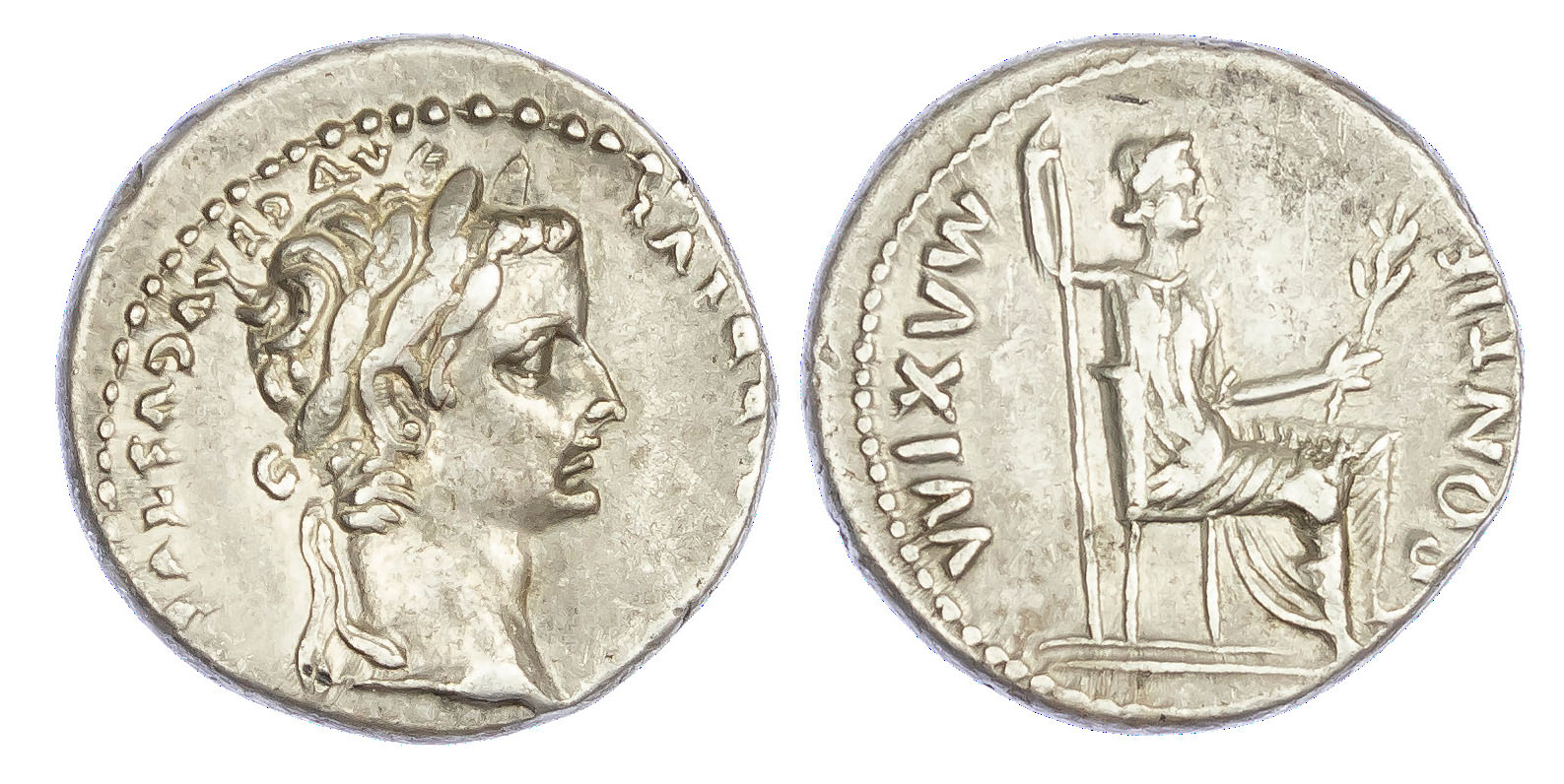
Source: https://www.baldwin.co.uk/wp-content/uploads/2022/08/C223004321-1-20220825090152.jpg
https://timhieuthanhkinh.com/wp-content/uploads/2025/12/C223004321-1-20220825090152.jpg
The denarius was the standard Roman currency during the New Testament period. Its value was roughly equivalent to the daily wage of an ordinary laborer, a soldier, or an agricultural worker (as referenced in the parable of the laborers in the vineyard, Matthew 20:2-13).
The denarius circulating at the time of the Lord Jesus, under Emperor Tiberius, typically had the following features:
-
Obverse: It bore the portrait of Emperor Caesar Tiberius wearing a laurel wreath, along with the Latin inscription “TI[BERIVS] CAESAR DIVI AVG[VSTI] F[ILIVS] AVGVSTVS” (“Tiberius Caesar, Son of the Divine Augustus, Augustus”). This inscription not only affirmed his political authority but also declared Tiberius’ “divine” status as the son of a god (Augustus had been deified by the Roman Senate).
-
Reverse: It depicted a seated woman on a throne (commonly thought to be Livia, Tiberius’ mother, portrayed as a deity, or Pax, the Goddess of Peace), with the inscription “PONTIF[MAXIM]” (“Chief Priest”). This proclaimed Tiberius as the supreme religious leader of the entire Roman Empire.
When the Lord Jesus asked, “Show Me the tax money,” those who sought to trap Him handed Him a denarius. He likely held up the coin, showing the side with the emperor’s image toward them, and asked, “Whose image and inscription is this?” This question placed the Pharisees—who prided themselves on religious purity—in a highly contradictory position:
They were forced to admit, “Caesar’s.” This was obvious and undeniable.
Yet that very admission exposed them: they were carrying and using an object bearing the image and title of a man who claimed divinity, a direct violation of the commandment against idolatry (Exodus 20:4). Moreover, the coin also declared Caesar to be “Chief Priest,” a position that, according to Jewish tradition, belonged only to the line of Aaron and symbolized the exclusive priestly authority of the God of Israel.
The seemingly simple question of the Lord Jesus actually exposed the hypocrisy and compromise of those who were accusing Him. They used Caesar’s money and acknowledged his economic system, yet sought to use the law of the God to accuse others for using that money. This made His answer—”Render therefore to Caesar the things that are Caesar’s”—all the more profound and weighty.
But the Lord Jesus did not stop there. He also reminded them to fulfill their duty to the God. They must render to the God the things that belong to the God.
The complete answer of the Lord Jesus was not only a clever way to escape the trap but also a declaration full of authority, putting everything in its proper place.
The statement, “Render therefore to Caesar the things that are Caesar’s,” addressed and nullified the trap. In speaking this, the Lord Jesus:
-
Acknowledged the reality of social order and government.
-
Exposed the hypocrisy of those questioning Him, since they were already using and acknowledging Caesar’s system.
-
Completely resolved the dilemma. He neither opposed nor unconditionally endorsed it. He simply defined the scope of what belongs to Caesar: the coin bearing his image and inscription and the civil obligations arising from it.
The statement, “and to *God the things that are *God’s,” is the key and climactic part, transforming the answer from an ordinary political remark into a resounding theological declaration. In saying this, the Lord Jesus:
-
Reminded everyone that there is an authority higher, first, and above all earthly authorities.
-
So, what belongs to the God? The implicit answer is EVERYTHING: “The earth is the Lord’s, and all its fullness, The world and those who dwell therein” (Psalms 24:1). But above all, it is each person, since they are created in the image and likeness of the God (Genesis 1:27). Therefore, ultimate loyalty, worship, love, and complete obedience of each person must belong to the God.
-
This is the true answer to the implication of the initial question (“Is it lawful… according to the law of the God?”). The Lord Jesus’ statement can be understood as follows: You ask about taxes? Attend to your earthly duties. But do not forget what is infinitely more important: give to the God what belongs to Him—that is, your life, your faithfulness, and your worship.
In summary, the Lord Jesus:
-
Broke the trap with wisdom.
-
Reversed the situation to expose the hypocrisy of His opponents.
-
Established an eternal principle regarding two kinds of obligations: civil and spiritual.
-
And most importantly, directed all things toward the God, placing Him at the center and as the supreme authority over every area of life.
The Lord Jesus’ answer not only resolved the immediate situation but also serves as a guiding principle for all of God’s people throughout all ages on how to live out their faith in the world. That is, “to live in the world but not be of the world” (John 17:14-16). They must always remember that obedience and worship of the God must be the highest priority.
Matthew 22:22
22 When they had heard these words, they marveled, and left Him and went their way.
Luke 20:26
26 But they could not catch Him in His words in the presence of the people. And they marveled at His answer and kept silent.
The Lord Jesus’ answer left those who were trying to trap Him astonished. Not only were they unable to ensnare Him, but they also created an opportunity for the crowd to witness the extraordinary wisdom of the Lord Jesus—a wisdom surpassing that of all the teachers of the Word at that time.
Their astonishment was not admiration but shock and helplessness. They could not believe that their carefully crafted trap had been undone so neatly and elegantly.
They could find no fault in the Lord’s words, yet they did not know how to respond, so they remained silent and likely withdrew gradually from the scene.
Their silence was a sign of complete failure. In a culture that prized public debate, the inability to respond was a humiliation. They had nothing to say because the Lord’s words had covered every corner of their trap.
The crowd witnessing this confrontation clearly saw who possessed true authority and extraordinary wisdom. While the scribes and Pharisees often relied on convoluted and intricate arguments, the Lord Jesus presented a principle that was simple, profound, and unassailable.
This not only strengthened the authority of the Lord Jesus but also diminished the influence of the contemporary religious leaders. The people saw the difference between wisdom from heaven and human cleverness.
“They marveled, and left Him and went their way” demonstrated their complete surrender. They had no reason to remain. Every scheme had been thwarted. However, this withdrawal was not repentance but a nurturing of deeper hatred. This failure became one of the reasons they were determined to find another way to arrest and kill Him. Two days later, they used force and an unjust trial to carry out their plan.
The lesson for us is:
-
The truth of the God always stands firm and triumphs over all human cleverness and schemes.
-
True wisdom does not lie in winning arguments but in the ability to expose the human heart and direct all things toward the God.
-
When facing hostile questioning today, the principle of “Render to Caesar…” remains a guiding compass. This means be faithful in your civic duties, but always maintain ultimate loyalty and worship reserved for the God. For “We must obey God rather than men” (Acts 5:29).
We conclude this lesson here.
May the Holy Spirit guide us into all the truths of God’s Word (John 16:13). May the Word of God sanctify us (John 17:17). May the Faithful *God of Peace Himself sanctify our spirit, soul, and body entirely, without blame (1 Thessalonians 5:23), at the coming of our Lord Jesus Christ, our Beloved Savior. Amen!
Timothy Christian Huynh
Priscilla Christian Huynh
12/20/2025
Note:
About Using “*God”, “the God” and “holy spirit”
Wherever the Hebrew, Aramaic, and Greek texts of the Bible use a definite article with a noun to denote GOD, we translate it into English as *God or “the God” to refer to God the Father. We understand that “God,” without a definite article, was used as a collective noun for all and any of the three Persons of the Godhead. And “God,” with a definite article, was used to refer to God the Father.
In the Greek manuscripts of the New Testament, the term “holy spirit” (πνευματι αγιω) without the definite article “the” (το) is used to denote the power of God, which is given by God the Holy Spirit. “The Holy Spirit” (το πνευματι το αγιω) is God, and “holy spirit” (πνευματι αγιω) is the power that comes from God.


 Users Today : 89
 Users Yesterday : 119
 Users This Year : 18865
 Total Users : 78405
 Views Today : 101
 Total views : 126798
 Who's Online : 0