Commentary on the Four Gospel Books
The Gospel of the Lord Jesus Christ
G005 The Genealogy of the Christ – Part 1
Matthew 1:1–17; Luke 3:23–38
Download PDF:
https://od.lk/f/MV8zNTU1NTU3MDlf
https://od.lk/fl/MV8xODI0MzMzNl8
Please share this website with all your friends and family members. Thank you, and God bless.
All New Testament verses quoted in this article are from the English Majority Text Version, and Old Testament verses are from the King James Version, unless otherwise noted.
Matthew 1:1-17
1 The book of the genealogy of Jesus Christ, the Son of David, the Son of Abraham:
2 Abraham begot Isaac, Isaac begot Jacob, and Jacob begot Judah and his brothers.
3 Judah begot Perez and Zerah by Tamar, Perez begot Hezron, and Hezron begot Ram.
4 Ram begot Amminadab, Amminadab begot Nahshon, and Nahshon begot Salmon.
5 Salmon begot Boaz by Rahab, Boaz begot Obed by Ruth, Obed begot Jesse,
6 and Jesse begot David the king. David the king begot Solomon by her who had been the wife of Uriah.
7 Solomon begot Rehoboam, Rehoboam begot Abijah, and Abijah begot Asa.
8 Asa begot Jehoshaphat, Jehoshaphat begot Joram, and Joram begot Uzziah.
9 Uzziah begot Jotham, Jotham begot Ahaz, and Ahaz begot Hezekiah.
10 Hezekiah begot Manasseh, Manasseh begot Amon, and Amon begot Josiah.
11 Josiah begot Jeconiah and his brothers at the time of the captivity in Babylon.
12 And after the captivity in Babylon, Jeconiah begot Shealtiel, and Shealtiel.
13 Zerubbabel begot Abiud, Abiud begot Eliakim, and Eliakim begot Azor.
14 Azor begot Zadok, Zadok begot Achim, and Achim begot Eliud.
15 Eliud begot Eleazar, Eleazar begot Matthan, and Matthan begot Jacob.
16 And Jacob begot Joseph the husband of Mary, of whom was born Jesus who is called Christ.
17 So all the generations from Abraham till David were fourteen generations, from David until the captivity in Babylon were fourteen generations, and from the captivity in Babylon until the Christ were fourteen generations.
Luke 3:23-38
23 Now Jesus Himself began His ministry at about thirty years of age, being (as it was supposed) the son of Joseph, the son of Heli,
24 the son of Matthat, the son of Levi, the son of Melchi, the son of Janna, the son of Joseph,
25 the son of Mattathiah, the son of Amos, the son of Nahum, the son of Esli, the son of Naggai,
26 the son of Maath, the son of Mattathiah, the son of Semei, the son of Joseph, the son of Judah,
27 the son of Joannas, the son of Rhesa, the son of Zerubbabel, the son of Shealtiel, the son of Neri,
28 the son of Melchi, the son of Addi, the son of Cosam, the son of Elmodam, the son of Er,
29 the son of Jose, the son of Eliezer, the son of Jorim, the son of Matthat, the son of Levi,
30 the son of Simeon, the son of Judah, the son of Joseph, the son of Jonan, the son of Eliakim,
31 the son of Melea, the son of Menan, the son of Mattathah, the son of Nathan, the son of David,
32 the son of Jesse, the son of Obed, the son of Boaz, the son of Salmon, the son of Nahshon,
33 the son of Amminadab, the son of Aram, the son of Joram, the son of Hezron, the son of Perez, the son of Judah,
34 the son of Jacob, the son of Isaac, the son of Abraham, the son of Terah, the son of Nahor,
35 the son of Serug, the son of Reu, the son of Peleg, the son of Eber, the son of Shelah,
36 the son of Cainan, the son of Arphaxad, the son of Shem, the son of Noah, the son of Lamech,
37 the son of Methuselah, the son of Enoch, the son of Jared, the son of Mahalalel, the son of Cainan,
38 the son of Enos, the son of Seth, the son of Adam, the son of *God.
“Genealogy” in Sino-Vietnamese is ″gia phả,″ which refers to a book that records events related to the lineage of a family. ″Gia″ means family or clan, while ″phả″ (also read as ″phổ″) is a book that systematically records people and events. This is also the meaning in the original Hebrew or Greek of the Bible.
The Gospel of Matthew begins with the genealogy of the Lord Jesus Christ to demonstrate that He is a descendant of Abraham and a descendant of King David and that He is the Christ, that is, the Messiah promised in the Old Testament Scriptures. The Messiah (in Hebrew) or Christ (in Greek) is the one anointed by God, meaning He is granted the office, authority, and power to serve as prophet, high priest, and king over Israel as well as over all nations.
The Gospel of Luke, on the other hand, places the genealogy of the Christ at the end of chapter 3, after narrating His birth and the beginning of His ministry, to show that He is fully human, belonging to the lineage of mankind, and is a complete, real human being.
However, aside from some points of similarity, the two genealogies have many significant differences. The main reason for these differences is that Matthew records the genealogy of the Lord Jesus Christ through His legal father, Joseph, and traces it only back to Abraham. Luke, on the other hand, records it through His biological mother, Mary, and traces the full lineage back to Adam, the first man. Both Joseph and Mary are descendants of King David: Joseph through Solomon’s line, and Mary through Nathan’s line.
The Gospels of Mark and John do not record the genealogy of the Lord Jesus Christ. The likely reason is that Mark presents the Lord Jesus as a servant, and when speaking of a servant, a genealogy is not necessary. John presents the Lord Jesus as God incarnate, and God has no genealogy, for God is the Self-Existing and Eternal One.
Matthew presents the Lord Jesus as a king and the Savior of mankind, so a genealogy is necessary. Luke presents Him as a complete human being, worthy to be the Savior of mankind, so a genealogy is also necessary. It is likely that both Matthew and Luke relied partly on genealogies recorded in the Old Testament and partly on genealogies outside the Scriptures of King David’s descendants, which had been registered with the Public Record Office and copied and preserved there. We can understand that most of the names in Luke’s genealogy, from after the exile up to Christ, were likely drawn from Mary’s family records.
Since the two genealogies were first published, nearly two thousand years have passed, yet questions and debates about the details in them have never ceased. We have spent considerable time consulting many explanations and numerous discussions, but most of those materials did not fully satisfy us. In this article, we present our observations and reflections, based on the records in the Scriptures and on the understanding that God the Holy Spirit has given us. Readers are not required to accept what we present. Each person should compare what we present with God’s Word and ask the Lord to guide them in discerning whether our presentation is consistent with His Word. We are merely guiding God’s people to meditate on His Word, based directly on the Word itself, so that they may gain deeper understanding of God’s Word and continually find joy and satisfaction in the truth of His Word.
The important point is that, even when there are parts of Scripture we do not fully understand, we should remain steadfast in faith that God’s Word is Truth. If there are any errors or mistakes in the manuscripts or translations, over time the Lord will reveal them to us, provided we take the time to read and meditate on His Word. Of course, if we also study historical materials from the Church, documents written by God’s people in the early centuries of the Church, and secular historical records, we will gain additional knowledge to understand God’s Word in the social context in which it was recorded. Most of these materials have been translated into English, the widely used language today. Believers who do not yet know English should spend time learning to read English by comparing the English Bible with the Vietnamese Bible and using an English-Vietnamese dictionary. Google Translate can also be used to hear the pronunciation of English words and sentences. After approximately six months of studying in this way for an average of one hour per day, brothers and sisters will notice significant progress. Then, they can practice reading Church literature and history in English.
A modern tool that God has given us is AI networks that can translate from one language to another very quickly, even though the accuracy is not yet perfect. ChatGPT is one of the AIs capable of fairly accurate translation. A person can use ChatGPT to translate articles from English into their native language, and vice versa.
Below is a summary table of the genealogy of the Lord Jesus Christ, according to Matthew and Luke.
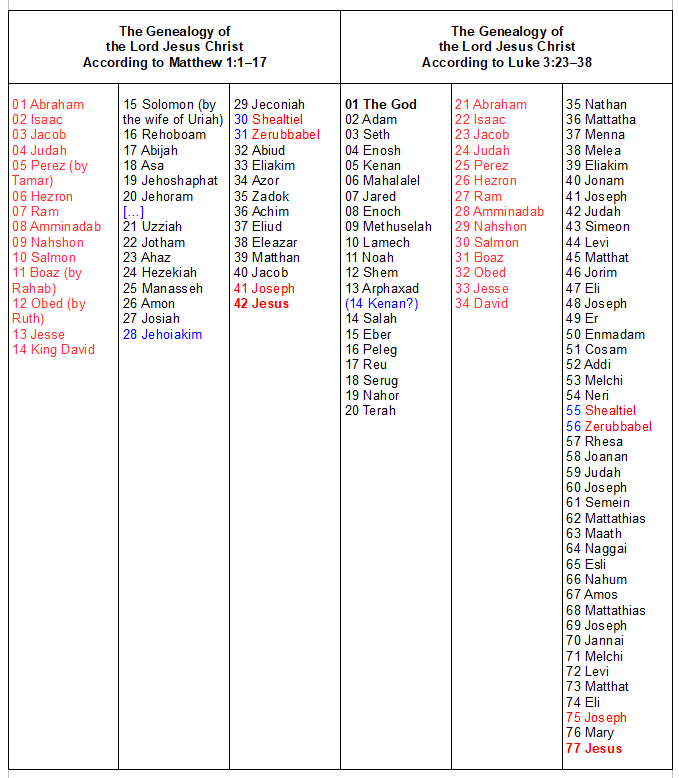
The red text highlights the names that are the same in both genealogies.
In Matthew’s genealogy, between the names Jehoram and Uzziah, there is a set of three dots in blue brackets, indicating a question or uncertainty. This reflects that Matthew omitted the names of three consecutive kings: Ahaziah, Jehoash, and Amaziah (1 Chronicles 3:11–12). The likely reason these three kings were skipped is that they were descendants of Queen Athaliah, the wife of King Jehoram.
Athaliah was an evil queen. She was the daughter of King Ahab and Queen Jezebel, both of whom were also notoriously wicked. After King Ahaziah, the son of Jehoram and Athaliah, died, Athaliah had all the princes killed so that she could ascend the throne and rule the kingdom of Judah. However, Jehosheba, the sister of Ahaziah, hid Ahaziah’s infant son, Jehoash (also called Jehoahaz). When Athaliah had ruled for seven years and Jehoash was seven years old, the high priest Jehoiada collaborated with the military leaders to overthrow Athaliah and establish Jehoash as king (2 Kings 11).
Thus, the three kings descended from Athaliah were not recorded in the genealogy of the Lord Jesus. It was not until King Uzziah, the fourth-generation descendant of Queen Athaliah, that a descendant from her line appears in the genealogy.
In Matthew’s genealogy, the name Jehoiakim appears in blue with a question mark, indicating a possible uncertainty.
Matthew 1:11 in the Greek manuscript copies reads:
″Josiah begot Jeconiah and his brothers at the time of the captivity in Babylon.″ (Matthew 1:11)
However, it is likely that the manuscript copies mistakenly recorded the name Jehoiakim instead of Jeconiah. Jeconiah, also called Jehoiachin, was the son of Jehoiakim (2 Kings 24:6).
In fact, Josiah fathered Jehoiakim and his brothers. According to 1 Chronicles 3:15, Josiah’s firstborn was Johanan; the second was Jehoiakim; the third was Zedekiah; and the fourth was Shallum. Jehoiakim, in turn, fathered Jeconiah and Zedekiah. Therefore, it is not accurate to say that Josiah fathered Jeconiah and his brothers.
We should note that both the brother and the son of Jehoiakim bore the name Zedekiah. In reality, Jehoiakim’s brother was named Mattaniah, whom the king of Babylon installed as king in place of Jehoiachin (i.e., Jeconiah) and changed his name to Zedekiah (2 Kings 24:17).
Some Hebrew manuscript copies of the Gospel of Matthew record Jehoiakim’s name instead of Jeconiah in Matthew 1:11, which aligns correctly with the data in the Old Testament.
We believe that the Greek manuscript copies contained an error, which also resulted in a missing name in the list of 14+14+14=42. Without the name Jehoiakim, the total number of names would be only 41, which does not match the statement in Matthew 1:17.
In Luke’s genealogy, the name Kenan appears in blue with a question mark, indicating a possible uncertainty.
In the Greek manuscript copies of the Gospel of Luke, Kenan is recorded in Luke 3:36, between the names Shelah and Arphaxad. However, in the Hebrew manuscript copies of the Old Testament, there is no record that Shelah was the son of Kenan or that Kenan was the son of Arphaxad. On the contrary, the Hebrew Old Testament manuscripts consistently record:
″And Arphaxad begat Salah; and Salah begat Eber.″ (Genesis 10:24)
However, in the Old Testament Septuagint (LXX), Genesis 10:24 does include the name of Kenan:
″And Arphaxad begot Kenan, and Kenan begot Salah; and Salah begot Eber.″ (Genesis 10:24 – Bản Dịch 70)
The Old Testament Septuagint (LXX) is a translation of the Hebrew Scriptures into Greek, completed around the middle of the third century BCE. The Septuagint was used by the Lord Jesus Christ and the early Church [2].
We believe that Luke may not have originally included the name Kenan in Luke 3:36. However, when the Gospel of Luke was copied in the early Church, the scribes may have compared Luke’s genealogy of the Lord Jesus Christ with Shem’s genealogy in the Septuagint. Thinking that Luke had omitted Kenan’s name, they may have added it on their own.
We believe that the original Scriptures, that is, the autographs inspired by God, are absolutely without error or fault. However, the copied manuscripts and translations contain errors in transcription and translation. Therefore, the original Hebrew Old Testament is without error, but the Septuagint may contain mistakes. One such error may be the inclusion of the name Kenan in Genesis 10:24 for some reason.
We believe that God ordained that the descendants of humanity from Noah would form 70 nations, as listed in Genesis 10. Therefore, Genesis 10:24 cannot include the name Kenan; including him would make 71 nations. The number 70 in Scripture symbolizes complete spiritual order manifested in full strength. It is formed from two numbers that also represent completeness. The number 7 signifies spiritual completeness, or completeness in anything sacred. The number 10 signifies completeness in quantity and law, as seen in the ten fingers and ten toes of humanity, the decimal counting system, and God’s Ten Commandments.
We believe that God allows some minor errors and mistakes to occur in the copies and translations of Scripture—errors that do not distort the meaning of His Word—in order to highlight the absolute perfection of the original autographs. Those who copied and translated the Scriptures were blessed by God to carry out their work, but they were not inspired. God inspired the originals fully, once and for all.
Today, the original manuscript copies of the Scriptures no longer exist. However, by comparing the copies derived from the originals, Bible scholars who have reverence for God and are gifted by Him can still discern which copies faithfully reflect the originals.
We believe that the reason God did not allow the original manuscript copies to remain is to prevent humanity from idolizing or worshiping them. It is also possible that the originals are preserved somewhere by God. When the Millennial Kingdom is established, He may allow the original manuscripts to appear so that everyone can read God’s Word in its original form. That will be a tremendous blessing.
Although the names Shealtiel and Zerubbabel appear consecutively in both Matthew’s and Luke’s genealogies, the Shealtiel and Zerubbabel in Matthew are different from those in Luke. One line represents the descendants of David through Solomon, and the other represents the descendants of David through Nathan. We must understand that, from Solomon and Nathan onward, it is impossible for the individuals in Luke’s genealogy to be the same as those in Matthew’s genealogy, because they were born into entirely different branches of David’s lineage.
In Matthew’s genealogy it states, ″And Jacob begot Joseph the husband of Mary.″ In Luke’s genealogy it states, ″Now Jesus Himself began His ministry at about thirty years of age, being (as it was supposed) the son of Joseph, the son of Heli.″ Thus, the name Joseph in both genealogies refers to the same person, Mary’s husband and the legal father of the Lord Jesus.
It is clear that Matthew’s genealogy traces Joseph’s line. He is the son of Jacob, traced back through Solomon, and then to David. Although the Lord Jesus was Joseph’s adopted son, He was legally recognized as such, giving Him the right to inherit David’s throne—the throne that God had promised to David’s descendants forever.
″And thine house and thy kingdom shall be established for ever before thee: thy throne shall be established for ever.″ (2 samuel 7:16)
Matthew’s genealogy aims to demonstrate, from a legal perspective, that the Lord Jesus belongs to the line of King David through Solomon, giving Him the right to sit on David’s throne. However, by the time of King Jeconiah (Jehoiachin), God declared that none of Jeconiah’s descendants would ever sit on David’s throne (Jeremiah 22:30).
Thus, if the Lord Jesus had been Joseph’s biological son, He could not have inherited David’s throne because of that curse. In reality, the Lord Jesus was not Joseph’s biological son, so the curse did not affect Him. Yet, if He was not Joseph’s biological son, He would not belong to David’s bloodline. The Lord Jesus had to be of David’s lineage by blood for the prophecy concerning the Messiah to be fulfilled.
″And there shall come forth a rod out of the stem of Jesse, and a Branch shall grow out of his roots.″ (Isaiah 11:1)
″And in that day there shall be a root of Jesse, which shall stand for an ensign of the people; to it shall the Gentiles seek: and his rest shall be glorious.″ (Isaiah 11:10)
That is why God used Luke to record the genealogy of the Lord Jesus through Mary, His biological mother, to demonstrate that, in His physical body, He truly belonged to the bloodline of King David through Nathan’s line. Luke’s genealogy not only proves that the Lord Jesus is of David’s lineage but also shows that He is descended through a woman, since He had no biological father. In this way, God’s prophecy in Genesis is fulfilled:
″And I will put enmity between thee and the woman, and between thy seed and her seed; it shall bruise thy head, and thou shalt bruise his heel.″ (Genesis 3:15).
The word ″his″ in this verse refers to the one who would come from the lineage of a woman, that is, the Lord Jesus.
Although Joseph does not belong to Mary’s genealogy, he is His legal father, so his name is included in the genealogy. Luke carefully notes, ″being (as it was supposed) the son of Joseph.″ In this way, Mary’s name is implicitly represented in the genealogy.
Some biblical scholars argue that both genealogies are actually Joseph’s. According to them, Joseph is the biological son of Jacob, as Matthew clearly records. Yet Joseph is legally the son of Heli for one of two possible reasons:
1. Joseph was a son-in-law, adopted by Heli as his heir because Heli had no sons.
2. Joseph was legally Heli’s son, born through Jacob, who was Heli’s half-brother. The reason is that Heli died without a male heir, so Jacob married Heli’s wife to bear a son to continue Heli’s line, according to the law of the Old Testament:
″If brethren dwell together, and one of them die, and have no child, the wife of the dead shall not marry without unto a stranger: her husband’s brother shall go in unto her, and take her to him to wife, and perform the duty of an husband’s brother unto her. And it shall be, that the firstborn which she beareth shall succeed in the name of his brother which is dead, that his name be not put out of Israel.″ (Deuteronomy 25:5-6)
Thus, Joseph was the biological son of Jacob but also the legal son of Heli.
Either of the two reasons above could be possible. However, if that were the case, it would not demonstrate that the Lord Jesus has Davidic blood, since He is not Joseph’s biological son. Therefore, Luke’s genealogy must be the genealogy of the Lord Jesus through His mother. Mary’s name is implicitly included in the list, which comprises a total of 77 names. The name of the God appears at the beginning, signifying that the Lord Jesus is the Son of the God. Mary’s name appears at the end, signifying that the Lord Jesus is the Son of Man, as He often referred to Himself.
In Matthew’s genealogy, the verb ″begot″ (G1080), when applied to men, means ″caused to be born.″ In a broader sense, it can mean ″ancestor of.″ For example, the statement ″Abraham begot Isaac″ literally means that Abraham caused Isaac to be born. But if one says ″Abraham begot Levi,″ it should be understood in the broader sense: Abraham was the ancestor of Levi, because in fact Levi was Abraham’s great-grandson. Hebrews 7:9-10 helps us understand this broader meaning of ″begot″ as used in both the Hebrew and Greek Scriptures: ″Even Levi, the one receiving tithes, has paid tithes through Abraham, so to speak, for he was still in the loins of his father when Melchizedek met him.″ In other words, every person born into the world has existed in Adam from the time God created Adam.
In particular, Eve also came from Adam by God’s miracle. Therefore, Luke traced the lineage of the Lord Jesus Christ all the way back to Adam and concluded that Adam belonged to the God, that is, Adam is the son of the God. However, no man caused the Lord Jesus to be born, because it was God Himself who caused Him to be born in the Virgin Mary, according to the line of King David.
When the verb ″begot″ (G1080) is used for women, it means directly conceiving and giving birth, as in the phrase: ″of whom was born Jesus who is called Christ.″
In Luke’s genealogy, he uses a concise form of expression, ″the of,″ to indicate that one person is a child or descendant of another. For example, ″the [son] of Heli″ means he was a son or grandson of Heli. Luke’s use of ″the of″ emphasizes that, in His human nature, the Lord Jesus belonged to the bloodline of all the individuals listed in the genealogy, except for Joseph, who was His legal father.
The phrase ″being (as was supposed) the son of Joseph″ in Luke 3:23 means, according to custom, the Lord Jesus was considered the son of Joseph, but in reality, He belonged to Heli, a descendant of Heli.
We should understand the implication of Luke’s presentation of the Lord Jesus’ genealogy in the way he recorded it. Luke intends to convey:
The Lord Jesus:
-
is (the son of Joseph, according to custom, not by blood),
-
is a descendant of Heli (by blood, because He is the biological son of Mary, and Mary is the biological daughter of Heli),
-
is a descendant of Mattath (by blood, because Heli is the biological son of Mattath),
-
is a descendant of Levi (by blood, because Mattath is the biological son of Levi),
-
…
-
is a descendant of Adam (by blood, because Seth is the biological son of Adam),
-
is the Son of the God (in the sense of being created, because Adam was created by the will of the God).
Luke emphasizes that Adam ″belonged to the God,″ implying that Adam was created by the God in the position of a son of the God. Therefore, the God’s name appears at the head of the Lord Jesus’ genealogy.
Matthew’s genealogy contains 42 names, divided into three groups of 14.
Some biblical scholars suggest that Matthew intentionally arranged the genealogy this way for easier memorization. We believe, however, that Matthew recorded it faithfully according to historical records and under the inspiration of God the Holy Spirit. God the Holy Spirit guided him to omit three kings who were unworthy of being included in the genealogy. After compiling the list, Matthew observed that the genealogy of the Lord was evenly divided into three parts, which is why he recorded that observation in verse 17.
Other scholars propose that each Hebrew letter corresponds to a number, and the letters in David’s name add up to 14, so Matthew arranged the genealogy so that each historical period would contain 14 generations. Yet we see that from Abraham to David there are naturally 14 generations, and from Jeconiah to the Lord Jesus there are also naturally 14 generations. Only the segment from Solomon to Jehoiakim required omitting three generations to arrive at 14.
In the Bible, the number 7 symbolizes spiritual completeness. The number 14, being twice 7, implies that spiritual completeness is doubled after humanity’s fall into sin and subsequent redemption. God’s creation is complete, and God’s restoration of His creation is also complete. Therefore, the number 14 represents salvation. The 14th day of the first month in the Biblical calendar, corresponding to the Hebrew calendar, is the Passover, which symbolizes the atoning death of the Christ.
In Matthew’s genealogy, the verb ″begot″ (G1080) appears 40 times: 39 times in the active sense, meaning ″ancestor of,″ and once in the passive sense, referring to the Lord Jesus being born of Mary.
The reason Matthew’s genealogy stops at Abraham and emphasizes King David is to demonstrate that the Lord Jesus is the Christ, the promised Messiah of the Old Testament, belonging to the line of the promised covenant, that is, the line of Abraham.
Luke’s genealogy contains 77 names, including God and Mary. Mary’s name is implied in the phrase ″being (as it was supposed) the son of Joseph″ (verse 23), to affirm that the Lord Jesus was not Joseph’s biological son, so Mary’s name must be understood as included in the list. At that time, Israelite genealogies typically did not record the names of women, except for the special notes added by Matthew in his genealogy, which we will examine later.
In Luke’s genealogy, each name is preceded by the definite article, except for Joseph in verse 33. This implies that although Joseph is listed in the genealogy, he does not truly belong to the line of Nathan.
The number 7 symbolizes spiritual completeness or the fullness of anything sacred. The number 10 represents completeness in quantity and the law. The number 77 is the sum of 7×10 + 7, symbolizing spiritual completeness multiplied tenfold, and then repeated once more, signifying absolute completeness according to God’s law and will.
The inclusion of Adam and the God in Luke’s genealogy serves to demonstrate that the Christ truly belongs to the lineage of humanity, being fully human. He Himself referred to Himself as the ″Son of Man.″
When we take the time to meditate on and study the genealogy of the Lord Jesus Christ as recorded in the Scriptures, we perceive the spiritual significance and the precision in every detail of the God’s plan of salvation for humanity, a plan predestined by the God even before creation, in His foreknowledge of all things.
What is profoundly important for us to recognize is that each of us, as true children of God, is also included in the genealogy of Christ. Our names will be written following the name of Christ on the day He gives each of us a new name, inscribed on a white stone (Revelation 2:17).
In the next article, we will explore the meaning of each Scripture verse in the two segments recording the genealogy of the Lord Jesus Christ.
May the Holy Spirit guide us into all the truths of God’s Word (John 16:13). May the Word of God sanctify us (John 17:17). May the Faithful *God of Peace Himself sanctify our spirit, soul, and body entirely, without blame (1 Thessalonians 5:23), at the coming of our Lord Jesus Christ, our Beloved Savior. Amen!
Timothy Christian Huynh
Priscilla Christian Huynh
09/09/2022
Notes:
[1] https://www.earlychristianwritings.com/
https://www.sacred-texts.com/index.htm
https://earlychurchhistory.org/
[2] https://www.septuagint.bible/
About Using “*God”, “the God” and “holy spirit”
Wherever the Hebrew, Aramaic, and Greek texts of the Bible use a definite article with a noun to denote GOD, we translate it into English as *God or “the God” to refer to God the Father. We understand that “God,” without a definite article, was used as a collective noun for all and any of the three Persons of the Godhead. And “God,” with a definite article, was used to refer to God the Father.
In the Greek manuscripts of the New Testament, the term “holy spirit” (πνευματι αγιω) without the definite article “the” (το) is used to denote the power of God, which is given by God the Holy Spirit. “The Holy Spirit” (το πνευματι το αγιω) is God, and “holy spirit” (πνευματι αγιω) is the power that comes from God.


 Users Today : 94
 Users Yesterday : 119
 Users This Year : 18870
 Total Users : 78410
 Views Today : 106
 Total views : 126803
 Who's Online : 0