Commentary on the Four Gospel Books
The Gospel of the Lord Jesus Christ
G105 The Story of a Rich Man and a Beggar Named Lazarus
Luke 16:19–31
Download PDF:
https://od.lk/f/MV8zNTUzNDAwNDVf
https://od.lk/fl/MV8xODI0MzMzNl8
Please share this website with all your friends and family members. Thank you, and God bless.
All New Testament verses quoted in this article are from the English Majority Text Version, and Old Testament verses are from the King James Version, unless otherwise noted.
Luke 16:19-31
19 “Now there was a certain rich man who was clothed in purple and fine linen, enjoying himself splendidly every day.
20 But there was a certain beggar named Lazarus, covered with sores, who had been placed at his gate,
21 and longing to be fed with the crumbs which fell from the rich man’s table. And even the dogs came and would lick his sores.
22 And it came to pass that the beggar died, and he was carried away by the angels to Abraham’s bosom. The rich man also died and was buried.
23 And being in torments in Hades, he lifted up his eyes and saw Abraham from afar, and Lazarus in his bosom.
24 Then he cried and said, ‘Father Abraham, have mercy on me, and send Lazarus so that he may dip the tip of his finger in water and cool my tongue; for I am suffering in this flame.’
25 But Abraham said, ‘Child, remember that in your lifetime you received your good things, and likewise Lazarus bad things, but now here he is comforted and you are suffering.
26 And besides all this, between us and you a great gulf has been fixed, so that those who desire to cross over from here to you are not able, nor may those from there cross over to us.’
27 Then he said, ‘Therefore I beseech you, father, that you would send him to my father’s house,
28 for I have five brothers, so that he may testify to them, lest they also come to this place of torment.’
29 Abraham said to him, ‘They have Moses and the prophets; let them hear them.’
30 And he said, ‘No, father Abraham; but if someone from the dead should go to them, they will repent.’
31 But he said to him, ‘If they do not hear Moses and the prophets, neither will they be persuaded should one rise from the dead.’ “
First of all, we need to recognize that the story of a rich man and a beggar named Lazarus is not a parable, but a true story. This is because in the 40 parables told by the Lord Jesus during His teachings, not a single one contains the name of any character. The reason the characters in the parables have no names is that they are not actual stories. And in this story, the Lord Jesus does not use physical events to teach spiritual truths, as He does in the parables. In this story, the Lord Jesus directly refers to spiritual truths concerning Hades.
Some Bible expositors believe that the Lord Jesus used a real story that was known among the people of that time to teach several important truths. It is the story of a beggar named Lazarus who lay at the gate of a rich man’s house, and later, both of them died. Of course, the people knew the details concerning the rich man and Lazarus while they were still alive. But the people could not know what happened to both of them in Hades.
We need to believe that all the spiritual and theological details in the story are true. These include the real existence of Hades; the suffering in Hades of those who do not belong to the Lord; the comfort after death of those who belong to the Lord; and the fact that after death, the soul still has awareness, sensation, and emotion.
The story of the rich man and Lazarus in Hades was told by the Lord Jesus after He had used the parable of the unrighteous steward to teach the disciples about being wise in managing money and material possessions in this life. This story was told so that the Lord’s disciples would clearly understand the consequences of unrighteousness in handling money and material possessions that the God has entrusted into each person’s hands, especially when living without compassion and without loving others as oneself.
Luke 16:19-21
19 “Now there was a certain rich man who was clothed in purple and fine linen, enjoying himself splendidly every day.
20 But there was a certain beggar named Lazarus, covered with sores, who had been placed at his gate,
21 and longing to be fed with the crumbs which fell from the rich man’s table. And even the dogs came and would lick his sores.
The “rich man” is someone who has an abundance of money and material possessions. The phrase “clothed in purple and fine linen” implies a life of luxury and splendor. The phrase “enjoying himself splendidly every day” implies a life in which every day all needs and desires are fully satisfied.
The “beggar” is the poorest person in society. The name “Lazarus” means “the one whom God helps.” This Lazarus is certainly different from the Lazarus of Bethany, the brother of Martha and Mary, who came from a well-off family and was called back to life by the Lord after his death.
The phrase “covered with sores” implies that in addition to being materially poor, Lazarus was also in poor health, with many sores on his body due to lack of hygiene and nutrition. That condition often accompanies poverty. Lazarus’s state suggests that he was likely in the final days of his life, no longer able to move on his own.
The phrase “had been placed at his gate” implies that someone had helped place the beggar Lazarus at the gate of the rich man’s house to beg for food. Perhaps that person hoped Lazarus would receive alms from the wealthy people coming and going to visit the master of the house or at least benefit from the leftover food from the rich man’s table.
The phrase “and longing to be fed with the crumbs which fell from the rich man’s table” shows that Lazarus did not even hope to eat the rich man’s leftovers but only wished to eat the crumbs that fell to the floor from the rich man’s table. This seems to imply that the rich man showed no concern or assistance toward Lazarus.
The phrase “And even the dogs came and would lick his sores” implies that various dogs would often come and lick the sores on Lazarus’s body. These were likely stray, ownerless dogs. While Lazarus was despised and abandoned by human society, the stray dogs came, befriended him, and licked his sores.
According to ancient medicine, a dog’s saliva might help cleanse wounds by removing dead tissue and foreign particles. However, according to modern medicine, dog saliva can also cause wound infections. From a psychological standpoint, Lazarus may have found some comfort in the companionship of the dogs that came to him and licked his sores.
Luke 16:22
22 And it came to pass that the beggar died, and he was carried away by the angels to Abraham’s bosom. The rich man also died and was buried.
The phrase ″the beggar died, and he was carried away by the angels to Abraham’s bosom″ contains the following truths:
1. The soul of a person is their true self. The soul continues to exist apart from the physical body after the death of the physical body.
2. Abraham had died thousands of years earlier, yet he still truly exists.
3. The souls of Israelites who belong to the Lord will be gathered together with Abraham, their forefather.
4. Angels have the task of bringing the souls of Israelites who belong to the Lord to be gathered with Abraham.
5. In the time of the Lord Jesus, the Israelites had the custom of reclining at the table during meals. The one most loved by the host would recline into the bosom of the host, or the disciple most beloved by the teacher would recline into the teacher’s bosom, such as the case of the Apostle John reclining into the bosom of the Lord Jesus during the Passover meal (John 13:23). The expression ″carried into the bosom of Abraham″ implies being warmly received by Abraham.
According to the Bible, a person is a soul within a spiritual body—the spirit—and together with the spirit, dwelling in a physical body—the flesh. When physical death occurs, the spirit returns to the God, the physical body returns to the dust (Ecclesiastes 12:7), and the soul enters into Hades. Hades is a spiritual realm, a temporary holding place for the souls of the dead, where they await the day they will be called to rise again for judgment. This is the judgment prophesied in Revelation 20:11–15.
Before the resurrection of the Lord Jesus, the souls of those who had faith in the God also entered into Hades after the death of their physical bodies. They were on the same side as Abraham, in contrast to the place where the rich man was. The Lord Jesus called that place Paradise, meaning the Garden of Delight (Luke 23:43). The souls in Paradise waited for the day the Lord Jesus would rise from the dead and bring them into Heaven.
Since the resurrection of the Lord Jesus, the souls of God’s people, after passing away, go directly to heaven, beside the Lord Jesus. The souls of the martyrs in the End Times will be under the altar in heaven (Revelation 6:9).
When the Deacon Stephen was about to die by stoning at the hands of the Jews, he saw the heavens open and saw the Lord Jesus standing at the right hand of the God, as if ready to welcome him into heaven (Acts 7:56). The Apostle Paul clearly stated that to die is to be with Christ (2 Corinthians 5:8; Philippians 1:23).
It was likely not long after Lazarus died that the rich man also died, and his body was buried. The phrase “was buried” implies that he was given a burial with grandeur and luxury, befitting his wealth. In other words, the rich man’s physical body, whether in life or in death, still enjoyed all that money and material possessions could provide.
Luke 16:23
23 And being in torments in Hades, he lifted up his eyes and saw Abraham from afar, and Lazarus in his bosom.
To envision the position of the rich man in Hades when he lifted up his eyes and saw Abraham and Lazarus, dear brothers and sisters, please read the article titled ″Ten Reflections on the Final Judgment″ that we have published on https://preachingfromthebible.net [1]. In that article, we present and illustrate with images the layout of Hades along with details related to it.
In Hades, the rich man was in torment because of the heat from the lake of fire within Hades. Although he had not yet been judged for each sinful deed and had not yet been cast into the lake of fire, he was already in pain from the heat of the fire, as he was under the punishment of the God. This is the punishment that follows a sinful life, prior to the final punishment on the day of the last judgment.
“For God did not send His Son into the world so that He might condemn the world, but that the world through Him might be saved. He who believes in Him is not condemned; but he who does not believe has been condemned already, because he has not believed in the name of the only begotten Son of God.” (John 3:17-18).
“He who believes in the Son has eternal life; and he who does not believe the Son will not see life, but the wrath of God abides on him.” (John 3:36).
The wrath of the God is His punishment upon those who rebel against Him and violate His commandments. This punishment begins with the death of the physical body in this life, continues with suffering in Hades after death, and is completed when the sinner is cast into the lake of fire at the end of the final judgment.
The suffering of the rich man in Hades and his awareness of Abraham and Lazarus show that the soul continues to have consciousness, sensation, and emotion after departing from the physical body. The awareness, sensations, and emotions we experience in dreams help us to somewhat understand the consciousness, sensations, and emotions of the soul in the spiritual realm.
Luke 16:24
24 Then he cried and said, ‘Father Abraham, have mercy on me, and send Lazarus so that he may dip the tip of his finger in water and cool my tongue; for I am suffering in this flame.’
The rich man’s recognition of Abraham is a mystery, similar to how the Lord’s three apostles recognized Moses and Elijah when the two appeared on the Mount of Transfiguration. We can understand that in the spiritual realm, each person will recognize one another without needing any introduction. That recognition is a gift from the God.
The rich man also recognized Lazarus, but the Bible does not show him expressing any regret for having lacked compassion and failing to help Lazarus while they were both still living in their physical bodies.
The thirst caused by the heat of the fire in the lake of fire led the rich man to plead with Abraham to send Lazarus to dip his finger in water and bring it to cool his tongue. This detail reveals the following theological truths:
1. The soul has consciousness, sensation, and emotion just as it did while still in the physical body.
2. Water in the spiritual realm also has the capacity to satisfy the thirst of the soul, just as water in the physical world does for the physical body.
3. Thus, eating and drinking in the spiritual realm also bring delight to the soul, just as eating and drinking in the physical world bring pleasure to the physical body.
4. Therefore, the resurrected or transformed bodies of God’s people will drink the water of life and eat the fruit of the tree of life in a manner similar to how the physical body eats and drinks in the material world.
5. The pain and longing of the soul in the spiritual realm are just as real as the pain and longing of the physical body in the material world.
The suffering of hunger and thirst—or the joy of eating delicious food—in a dream helps us in part to understand the sensations of the soul when it is no longer in the physical body.
Luke 16:25
25 But Abraham said, ‘Child, remember that in your lifetime you received your good things, and likewise Lazarus bad things, but now here he is comforted and you are suffering.
Abraham’s response to the rich man, calling him ″child,″ is an acknowledgment that he belonged to the lineage of Abraham. Those who belong to Abraham’s lineage are people within the covenant that God made with Abraham. They have the responsibility to live according to God’s commandments and laws, which the Lord Jesus summarized as follows:
“‘You shall love the LORD your God with all your heart, and with all your soul, and with all your mind.’ This is the first and great commandment. And the second is like it: ‘You shall love your neighbor as yourself.'” (Matthew 22:37-39).
While still living in his physical body, the rich man enjoyed the blessings that money and material possessions could bring, but he did not show love and compassion toward Lazarus. After his physical body died, the rich man had to suffer in Hades as the punishment from the God for those who violate His commandments.
Lazarus, while still living in his physical body, endured the hardships that the God allowed to come upon him. These hardships included poverty, deprivation, illness, being despised by others, and receiving no help or concern. Although the Bible does not state this explicitly, we can understand that in his difficult and humble condition, Lazarus remained fully faithful and trusted in the God. Therefore, he belonged to the God and received blessings after the death of his physical body.
Luke 16:26
26 And besides all this, between us and you a great gulf has been fixed, so that those who desire to cross over from here to you are not able, nor may those from there cross over to us.’
The term “Hades” has two meanings: the physical meaning refers to the tomb or grave where dead bodies are buried, while the spiritual meaning refers to the temporary holding place for the souls of the dead who have no salvation.
Spiritual Hades is not located underground, as many mistakenly believe. Because after the earth passes away, when the old heaven and old earth are gone, Hades and the lake of fire within Hades still remain.
Currently, there is no one in the lake of fire. In the bottomless pit are fallen angels who sinned before the Great Flood and are being imprisoned there. The area called Paradise existed only before the resurrection of the Lord Jesus; it was the temporary dwelling place of the saints before the New Testament era. After the Lord Jesus resurrected, He brought the saints into heaven (Ephesians 4:8).
Between the bottomless pit and the lake of fire is the place of temporary imprisonment for souls without salvation. We do not know what happened to Paradise after the Lord Jesus took the souls of the saints into heaven. It may have been removed from Hades. It may also still remain there for all imprisoned souls to see as a confirmation to them of the blessings of those who trust in God.
Once again, we kindly invite you, brothers and sisters, to read and listen to the sermon titled ″Ten Reflections on the Final Judgment″ to better visualize the areas within Hades. We hereby provide an illustrative image of Hades.
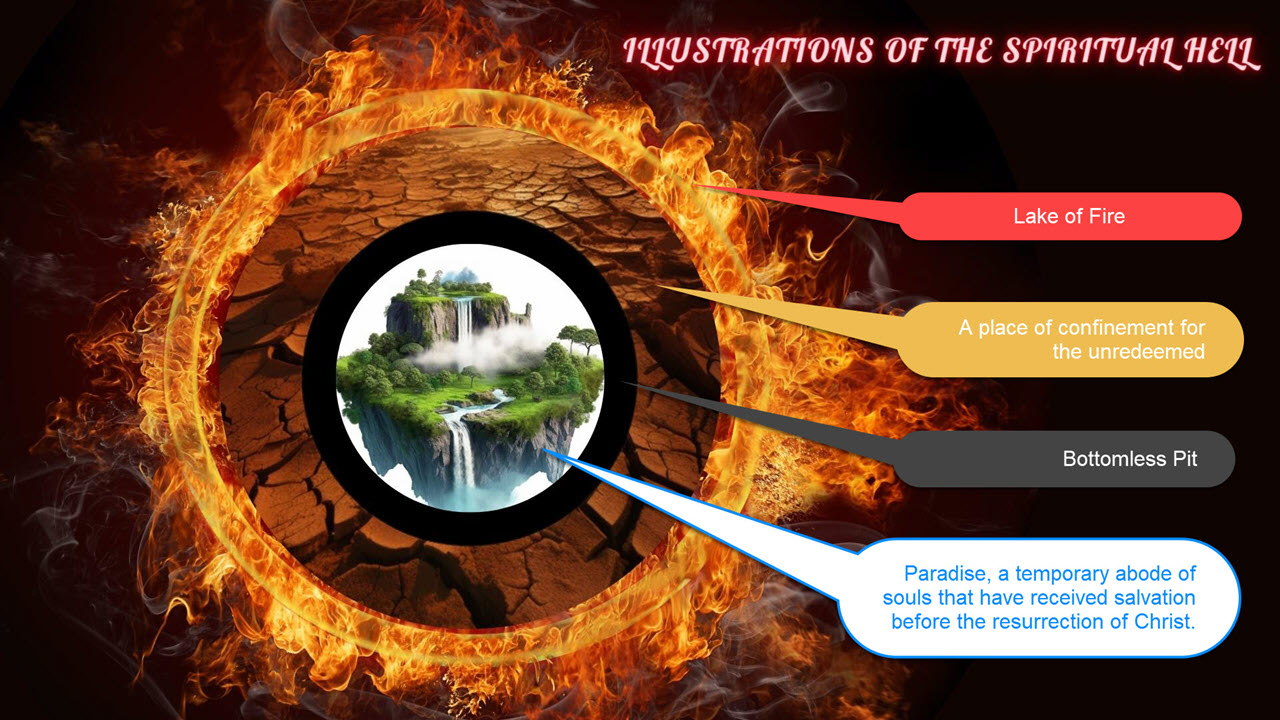 Illustration of Spiritual Hades
Illustrator: Phạm Trịnh Minh Anh
https://preachingfromthebible.net/wp-content/uploads/2024/09/Illustrations-of-the-Spiritual-Hell1280x720.jpg
Luke 16:27-28
27 Then he said, ‘Therefore I beseech you, father, that you would send him to my father’s house,
28 for I have five brothers, so that he may testify to them, lest they also come to this place of torment.’
The rich man’s words to Abraham show that he cared about his loved ones. He did not want his five brothers, who were still living, to suffer the same destruction as he did. The pronoun ″him″ in the rich man’s speech refers to Lazarus. He asked Abraham to send Lazarus to his family’s house to testify to them about what was happening to him. This was essentially a plea for Lazarus to be resurrected. The rich man did not ask for himself to be resurrected to testify to his brothers, probably because he knew he was not worthy and could not have such an opportunity.
The rich man’s plea shows that after the physical body dies, the soul still has awareness, emotions, thoughts, reasoning, and desires. This completely refutes the false doctrine of ″soul sleep″ taught by some religious organizations bearing the name of the Lord, chiefly the Seventh-day Adventist Church and the Jehovah’s Witnesses.
The false doctrine of soul sleep teaches that after death, the human soul is in an unconscious state, like ″sleeping,″ until the physical body is resurrected. The main points of this doctrine include:
- The soul of the dead has no consciousness, knows nothing, and feels nothing—similar to being in a deep, dreamless sleep.
- The soul of the dead does not immediately enter heaven or Hades.
The soul of the dead ″sleeps″ until the resurrection occurs. - The soul of the dead does not perceive time. For the dead, the period between death and resurrection will be like an instant. They ″sleep″ and then ″wake up″ immediately on the day of resurrection.
This doctrine arose when certain religious organizations applied Biblical verses about the state of the physical body after death to the soul.
Luke 16:29-30
29 Abraham said to him, ‘They have Moses and the prophets; let them hear them.’
30 And he said, ‘No, father Abraham; but if someone from the dead should go to them, they will repent.’
Abraham’s answer affirmed this truth: the content of the Old Testament Scriptures is sufficient to guide a person to live in a way that pleases the God.
The Lord Jesus summarized the commandments and laws of the God—that is, the entire teaching of Moses and the prophets—into His words as recorded in Matthew 22:37-39; and He affirmed:
“On these two commandments hang all the Law and the Prophets.” (Ma-thi-ơ 22:40).
The verb “hang” implies being based on a solid foundation. The entire law and the prophets rest on the two commandments regarding humanity’s duties toward God and toward one another.
The law requires humanity to love God and to love one another. The prophets foretold that the Lord Jesus Christ would come to fulfill the law by expressing His love for God and for humanity.
The rich man’s objection to Abraham implied that he believed the Old Testament Scriptures were not sufficient to help a person escape suffering in Hades. The rich man failed to realize that Lazarus, a descendant of Abraham like himself, did not need anyone to be raised from the dead in order to live a life in this world that would prevent suffering in Hades after death.
Luke 16:31
31 But he said to him, ‘If they do not hear Moses and the prophets, neither will they be persuaded should one rise from the dead.’ “
Abraham’s answer was proven true through the resurrection of the Lord Jesus from the dead, yet many people still do not believe His teachings. Abraham’s answer also implies that if a person does not believe the Old Testament Scriptures, they will not believe the New Testament Scriptures either. In fact, the New Testament records the story and teachings of the Lord Jesus Christ, a person who rose after dying to complete the redemption of humanity from the power and consequences of sin.
Today, if someone does not believe the Scriptures, even if a person rises from the dead to testify about heaven and Hades, that person will still not believe. The Scriptures are the Living Word of God, the truth. Those who do not believe the Scriptures cannot receive salvation.
We conclude this lesson here.
May the Holy Spirit guide us into all the truths of God’s Word (John 16:13). May the Word of God sanctify us (John 17:17). May the Faithful *God of Peace Himself sanctify our spirit, soul, and body entirely, without blame (1 Thessalonians 5:23), at the coming of our Lord Jesus Christ, our Beloved Savior. Amen!
Timothy Christian Huynh
Priscilla Christian Huynh
05/10/2025
Notes:
[1] https://preachingfromthebible.net/ten-reflections-on-the-final-judgment/
About Using “*God”, “the God” and “holy spirit”
Wherever the Hebrew, Aramaic, and Greek texts of the Bible use a definite article with a noun to denote GOD, we translate it into English as *God or “the God” to refer to God the Father. We understand that “God,” without a definite article, was used as a collective noun for all and any of the three Persons of the Godhead. And “God,” with a definite article, was used to refer to God the Father.
In the Greek manuscripts of the New Testament, the term “holy spirit” (πνευματι αγιω) without the definite article “the” (το) is used to denote the power of God, which is given by God the Holy Spirit. “The Holy Spirit” (το πνευματι το αγιω) is God, and “holy spirit” (πνευματι αγιω) is the power that comes from God.


 Users Today : 94
 Users Yesterday : 119
 Users This Year : 18870
 Total Users : 78410
 Views Today : 106
 Total views : 126803
 Who's Online : 0