Commentary on the Four Gospel Books
The Gospel of the Lord Jesus Christ
G007 The Prophecy about the Birth of John the Baptist
Luke 1:1-25
Download PDF:
https://od.lk/f/MV8zNTU2MTUxNDJf
https://od.lk/fl/MV8xODI0MzMzNl8
Please share this website with all your friends and family members. Thank you, and God bless.
All New Testament verses quoted in this article are from the English Majority Text Version, and Old Testament verses are from the King James Version, unless otherwise noted.
Luke 1:1-25
1 Since many have attempted to arrange a narrative about the matters which have taken place among us,
2 just as those who from the beginning were eyewitnesses and ministers of the word delivered them to us,
3 it seemed good to me also, having followed up accurately all things from above, to write to you in orderly fashion, most distinguished Theophilus,
4 so that you may know the certainty of those things in which you were instructed.
5 There was in the days of Herod, the king of Judea, a certain priest named Zacharias, of the division of Abijah. His wife was of the daughters of Aaron, and her name was Elizabeth.
6 And they were both righteous before *God, walking in all the commandments and ordinances of the Lord blameless.
7 But they had no children, because Elizabeth was barren, and they were both well advanced in years.
8 So it was, that while he was serving as priest before God in the order of his division,
9 according to the custom of the priesthood, he was selected to burn incense when he entered into the temple of the Lord.
10 And all the multitude of the people were praying outside at the hour of incense.
11 Then an angel of the Lord appeared to him, standing on the right side of the altar of incense.
12 And when Zacharias saw him, he was troubled, and fear fell upon him.
13 But the angel said to him, “Do not be afraid, Zacharias, because your prayer has been heard; and your wife Elizabeth will bear a son to you, and you shall call his name John.
14 And you will have joy and gladness, and many will rejoice at his birth.
15 For he shall be great before the Lord, and shall drink neither wine nor strong drink. He will also be filled with the Holy Spirit, while still in his mother’s womb.
16 And he will turn many of the sons of Israel to the Lord their *God.
17 And he himself will go before Him in the spirit and power of Elijah, ‘to turn the hearts of the fathers to the children,’ and the disobedient to the wisdom of the righteous, to make ready a people prepared for the Lord.”
18 And Zacharias said to the angel, “How shall I know this? For I am an old man, and my wife is well advanced in years.”
19 And the angel answered and said to him, “I am Gabriel, who stands before *God, and I was sent to speak to you and to proclaim the good news to you of these things.
20 But behold, you shall be silent and not able to speak until the day these things take place, because you did not believe my words which shall be fulfilled in their season.”
21 And the people waited for Zacharias, and they marveled at his delaying in the temple.
22 But having come out, he was unable to speak to them; and they recognized that he had seen a vision in the temple, for he was making signs to them and remained speechless.
23 And it happened, as soon as the days of his service were fulfilled, that he went away to his house.
24 Now after those days Elizabeth his wife conceived; and stayed in seclusion five months, saying,
25 “Thus the Lord has dealt with me, in the days when He looked on me, to take away my reproach among men.”
The four Gospel books in the Bible are Matthew, Mark, Luke, and John. Although all of them write about the Gospel of the Lord Jesus Christ, each book has a different beginning. The book of John begins with the introduction of His divine person, with the title ″the Word.″ The book of Matthew begins with the introduction of Him as a descendant of David and a descendant of Abraham, with a genealogy through Solomon, proving that He is qualified to sit on the throne of David. The book of Mark begins with the introduction of the ministry of John the Baptist, the one who prepared the way for His ministry. The book of Luke begins with an affirmation to give a true and orderly account of the events that took place concerning the Gospel of Christ. Following that is the prophecy about the birth of John the Baptist. Thus, Luke regarded the prophecy about the birth of John the Baptist as the beginning of the Gospel of the Christ.
The Gospel of Christ truly began with the event when the angel of the Lord prophesied to the father of John the Baptist about the birth of John the Baptist. For the purpose of John the Baptist’s birth was that he would go before, preparing the way for Christ. This was also what had been prophesied in the Old Testament.
In this lesson, we will together study the meaning of Luke 1:1-25, including Luke’s introduction to the book of Luke and the prophecy about the birth of John the Baptist.
Luke 1:1-2
1 Since many have attempted to arrange a narrative about the matters which have taken place among us,
2 just as those who from the beginning were eyewitnesses and ministers of the word delivered them to us,
″Many have undertaken to arrange″ means that many people had written down the events in an orderly manner.
″A narrative about the matters which have taken place among us″ refers to the account concerning the Lord Jesus, which Luke and other belivers whom Luke knew had believed.
Verse 2 means that Luke and his friends had believed in the account that was handed down to them by those who had recorded it. The verb ″delivered″ (G3860) used in this verse is similar to how it is used in 1 Corinthians 11:23. It means to hand over fully whatever needs to be handed over, from one person’s hand to another’s, with the purpose that the receiver has full authority to preserve and use it, or full authority to examine and discern it.
Those who had recorded the things concerning the Lord Jesus, as mentioned by Luke, were the ones who, from the very beginning, had themselves witnessed the events that took place, and they were also those who had ministered to Him. We should note that Luke did not write: ″they were ministers of the Lord Jesus″ or ″they were ministers of the Christ,″ but he wrote: ″they were ministers of the Word.″ For God the Holy Spirit, through Luke, wanted to emphasize the fact that when a person ministers to the Lord Jesus, that person is ministering to Christ, because He is the Christ, and at the same time, that person is ministering to God in the person of the Word. For the Lord Jesus is both man and God.
Those who ministered to the Word were not only His apostles but also all who worshiped Him and proclaimed His name. These included the shepherds who came to worship the Lord Jesus on the night He was born; Simeon and the prophetess Anna when they met the Lord Jesus in the Temple; and, about two years later, the wise men from the east who came to worship Him and presented gifts to Him. And thus, whoever believes in, worships, and proclaims the Lord Jesus is His minister.
The content of verse 2 also helps us understand that the Gospel of the Lord Jesus Christ written by Luke was not copied from the Gospel of Mark, as some commentators have speculated. For Luke clearly wrote that he recorded from the accounts of those who had seen and had ministered to the Word from the very beginning. Mark was not one who had seen and ministered to the Word from the beginning.
We can understand that, at that time, there were many documents recording the events concerning the Christ from those who had themselves seen Him, believed in Him, and proclaimed His name. Those documents had been handed down to God’s people in the Church in the beginning. Luke undertook the work of compiling the content of those documents to write the Gospel that bears his name. The purpose of Luke’s compiling those documents into one book is mentioned by him in verses 3 and 4.
Luke 1:3
3 it seemed good to me also, having followed up accurately all things from above, to write to you in orderly fashion, most distinguished Theophilus,
By reading the documents written by those who from the very beginning had themselves seen the Word and had ministered to the Word, Luke gained an accurate understanding of everything concerning the Christ from the very beginning. That beginning was initiated with the prophecy about the birth of John the Baptist, who was born to be the one preparing the way for Christ.
Luke recorded these events in their order of occurrence and wrote them into a book for an acquaintance of his, named Theophilus.
The Bible mentions the name Theophilus twice, in Luke 1:3 and in Acts 1:1, but says nothing further about him. The name Theophilus (G2321) in Greek means ″friend of God.″ Theophilus may have been a Roman or a Greek, acquainted with Luke, and a disciple of Christ. It is possible that Theophilus had requested Luke to write for him the accounts concerning the Christ, and Luke responded to his request by writing him a very long letter, which today is called the Gospel of the Lord Jesus Christ according to Luke. After that, Luke continued writing to Theophilus about the missionary work of the Church in the beginning, in another very long letter, which today is called the Acts of the Apostles.
Although both the Gospel of Luke and the Acts of the Apostles were originally two letters written by Luke and sent privately to Theophilus, God the Holy Spirit caused them to be copied many times and spread everywhere, to all of God’s people in the Church. Nearly two thousand years later, those two letters still reach billions of people in the world so that they may know the Gospel of the Lord Jesus Christ and know how the Church that He established began and grew.
The meaning of the name Theophilus is an interesting thing, because that name can be used to refer to anyone who is a disciple of Christ. Whoever is a disciple of Christ naturally becomes Theophilus, a ″friend of God.″ For they hear, believe, and follow all of His teachings. The Lord Jesus Himself said:
″You are My friends if you do what I command you. No longer do I call you servants, because a servant does not know what his master is doing; but I have called you friends, because all things which I heard from My Father I have made known to you.″ (John 15:14-15)
The God also once called Abraham His friend:
″But thou, Israel, art my servant, Jacob whom I have chosen, the seed of Abraham my friend.″ (Isaiah 41:8)
″And the Scripture was fulfilled which says, “Abraham believed *God, and it was accounted to him for righteousness.” And he was called a friend of God.″ (James 2:23)
It is very likely that Theophilus was a person of authority who believed in the Lord through Luke’s preaching.
Luke 1:4
4 so that you may know the certainty of those things in which you were instructed.
It is likely that Theophilus came to believe in the Gospel and learned about it through Luke. Luke undertook the work of compiling the events concerning the Lord Jesus Christ into a written account to help Theophilus have a clear and certain understanding of what he had learned about the Gospel.
From the very beginning of the Church, teaching new believers about the Lord Jesus Christ, that is, teaching them to observe all that He had commanded, was important and also part of the Lord Jesus Christ’s command, as recorded in Matthew 28:20. This teaching followed after bringing them to believe in the Gospel and baptizing them. Today, many religious organizations bearing the name of the Lord put the teaching of God’s Word before baptizing new believers. They call this ″basic doctrine,″ and only when a learner passes a test on the basic doctrine are they allowed to be baptized. This practice contradicts the command of Christ. A person must first believe in the Gospel, be baptized into the body of Christ, the Church, and only then receive the capacity from God to learn and understand God’s Word and live according to it.
Luke 1:5
5 There was in the days of Herod, the king of Judea, a certain priest named Zacharias, of the division of Abijah. His wife was of the daughters of Aaron, and her name was Elizabeth.
″In the days of Herod″ refers to the period when Herod the Great reigned as king of Judea, from 37 BCE to 4 BCE. He was the one who ordered the massacre of children two years old and under, hoping to kill the Lord Jesus (Matthew 2). The timing of the events Luke records in this passage is around 8 BCE. We can determine this by comparing details in the Bible with historical records.
Luke 1:6-7
6 And they were both righteous before *God, walking in all the commandments and ordinances of the Lord blameless.
7 But they had no children, because Elizabeth was barren, and they were both well advanced in years.
The couple Zechariah and Elizabeth both came from Aaron, of the tribe of Levi. The name Zechariah (G2197) is transliterated from Hebrew and means ″the Self-Existing and Eternal One remembers.″ The name Elizabeth (G1665) is also transliterated from Hebrew and means ″the oath of God.″ Together, their names mean: ″the Self-Existing and Eternal One remembers the oath of God.″ We can understand this as referring to God’s oath to Abraham that all nations would be blessed through his offspring (Genesis 22:16-18). God used Zechariah and Elizabeth to bring forth the one who would prepare the way for the Christ.
Although Zechariah and Elizabeth are recognized in the Bible as righteous, faithfully keeping all the commandments and statutes of the Lord, they had no children until old age. We do not know exactly how old Zechariah and Elizabeth were when this event occurred. But according to the biblical expression, ″they were both well advanced in years,″ they were at least over 60 years old. According to the Bible, over 60 is considered old age.
The circumstances of Zechariah and Elizabeth remind us of the situation of Abraham and Sarah. And, just like Isaac, the birth of John the Baptist was a miracle and according to God’s will. This also helps us understand that, often in our lives, God allows certain things to happen so that He may accomplish His purposes in our lives and display His glory. Therefore, we need to honor and give thanks to God in all things.
″In everything give thanks; for this is the will of God in Christ Jesus for you.″ (1 Thessalonians 5:18).
As long as each event that happens to us is not because of our sin, we can be confident that it is a blessing God has granted us. Remember the trials that came upon Job.
Luke 1:8-9
8 So it was, that while he was serving as priest before God in the order of his division,
9 according to the custom of the priesthood, he was selected to burn incense when he entered into the temple of the Lord.
″So it was″ refers to the appearance of the angel to him. This occurred while Zechariah was serving God in the Temple according to the order of the division of Abijah. In each priestly division, there were many priests responsible for different tasks. By the result of the lot, Zechariah’s task was to burn incense in the Temple of God. This was the work he carried out during the seven days of his shift.
Luke 1:10
10 And all the multitude of the people were praying outside at the hour of incense.
We do not know on which day of Zechariah’s shift the incense offering mentioned here took place. We also do not know whether it was the morning or evening incense. However, while Zechariah was performing the incense ritual inside the Temple, a large crowd of people had gathered outside in the Temple courtyard to pray. On ordinary days, people had to go about their work, so few would come to the Temple to pray. Therefore, it is very likely that the event of many people coming to the Temple to pray during the incense offering implies that it was the morning or evening incense on a Sabbath day.
If it was the morning incense on a Sabbath, then it would have been Zechariah’s final incense offering of his shift, because immediately afterward he would have handed over the shift to the priest of the next division. Each priestly division’s shift began after the Sabbath afternoon and ended before the following Sabbath afternoon.
Luke 1:11
11 Then an angel of the Lord appeared to him, standing on the right side of the altar of incense.
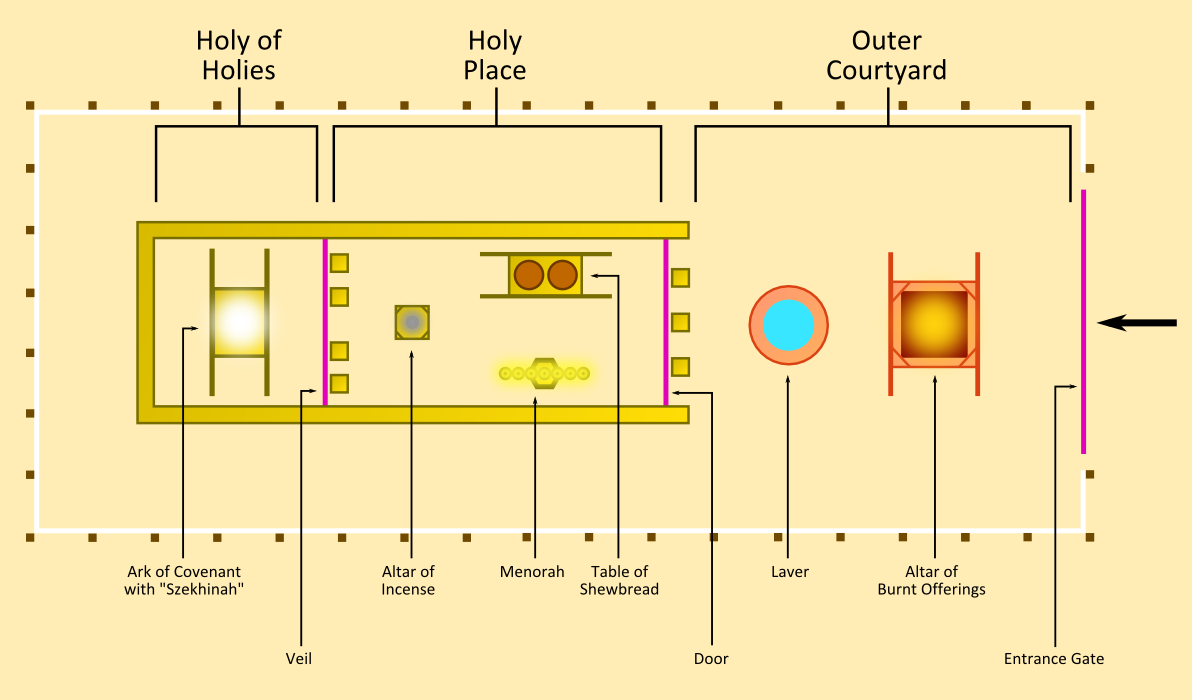 Source: https://graceandtruth.me/wp-content/uploads/2015/10/tabernacle.png
The noun ″the Lord″ used in this verse implies the Triune God. The Bible does not describe the form in which the angel appeared to Zechariah. However, it may have been in the form of a man wearing white clothing, as in other instances recorded in the Scriptures.
Luke 1:12-13
12 And when Zacharias saw him, he was troubled, and fear fell upon him.
13 But the angel said to him, “Do not be afraid, Zacharias, because your prayer has been heard; and your wife Elizabeth will bear a son to you, and you shall call his name John.
The sudden appearance of a person in the Temple caused Zechariah to be confused and afraid. He was confused because he did not understand why someone had appeared in the Temple. He was afraid because he thought something bad was about to happen. However, the angel immediately spoke to him so that he could understand and no longer fear.
The angel’s first words were to reassure Zechariah, telling him not to be afraid. This is also what the Lord Jesus often did for His disciples. Today, whenever we are afraid, we can call on the Lord Jesus Christ. He will grant us peace and take away our fear.
Next, the angel informed Zechariah that his prayer had been heard. From the angel’s words, we learn that Zechariah had prayed for the Lord to grant him and his wife a child. The angel also instructed Zechariah to name the son who would be born John. As we know, the name John (G2491) comes from Hebrew and means ″the Self-Existing and Eternal One is generous in giving.″ Not only did God grant Zechariah and Elizabeth a child, but He also used that child to carry out a great work for Him.
Luke 1:14
14 And you will have joy and gladness, and many will rejoice at his birth.
Zechariah would rejoice and be glad, not only because he was to have a child, but because his child would be a prophet of God, becoming the one who prepares the way for the Christ. John the Baptist is the last prophet of the Old Testament.
Many people rejoiced over the birth of John the Baptist, as recorded in Luke 1:58.
Luke 1:15
15 For he shall be great before the Lord, and shall drink neither wine nor strong drink. He will also be filled with the Holy Spirit, while still in his mother’s womb.
John the Baptist was to become great before God, even though to many people he might have seemed unusual. His value came directly from God. He was chosen and used by God to accomplish His work.
The fact that John the Baptist ″would neither drink wine nor any intoxicating drink″ implies that he would be set apart for God for his entire life, as a Nazirite (Numbers 6:3).
″Be filled with the Holy Spirit, while still in his mother’s womb″ means that God, in the person of the Spirit, granted John the Baptist God’s power and gifts even while he was still a fetus. This reminds us of what God did for the prophet Jeremiah:
″Then the word of the LORD came unto me, saying, Before I formed thee in the belly I knew thee; and before thou camest forth out of the womb I sanctified thee, and I ordained thee a prophet unto the nations.″ (Jeremiah 1:4-5)
The event of God filling His holy spirit (power) into a fetus is the event in which He sanctified that fetus. Here, sanctification means setting apart for God’s use. This sanctification is similar to what God does when He sanctifies an unbelieving husband or wife so that he or she may be joined to a believing spouse:
″For the unbelieving husband has been sanctified by the wife, and the unbelieving wife has been sanctified by the husband; otherwise your children would be unclean, but now they are holy.″ (1 Corinthians 7:14)
This does not mean that the person who is sanctified has had their sins forgiven or been made clean by God. Forgiveness of sins and being made clean can only occur through faith. Anyone who desires to have their sins forgiven and be made clean by God must believe in Him and obey Him. Believing and obeying God requires awareness and the exercise of free will. A person must recognize themselves as a sinner, recognize God’s grace of salvation, and consciously choose to believe in God and obey Him.
Catholic doctrine teaches that Mary, the mother of the Lord Jesus, was born ″immaculate,″ meaning she was born without being tainted by Adam’s sin. Some Catholics also believe that John the Baptist was born ″immaculate.″ However, the Bible clearly teaches that every person born from Adam is tainted by sin (Romans 5:12). Only the Lord Jesus, born of the God, was without sin. Mary herself confessed:
″And my spirit has rejoiced in *God my Savior.″ (Luke 1:47)
If Mary was born ″immaculate,″ then she would not have needed the God’s salvation and called Him ″my Savior.″
Luke 1:16
16 And he will turn many of the sons of Israel to the Lord their *God.
The noun ″Israel″ in this verse refers to Jacob. Whenever we read the phrase ″the descendants of Israel″ in the Bible, it emphasizes the lineage from Jacob, the one whom God renamed Israel, meaning: ″he who prevails with God″ (Genesis 32:28).
In reality, we do not know how many Israelites, through hearing John the Baptist’s preaching, repented, prepared themselves, and awaited the Christ. But when we read the book of Acts, we see that on the day the Church was established, about three thousand people were added to the Church (Acts 2:41). Among them, many may have heard John the Baptist preach and were baptized by him or by his disciples.
The noun ″Lord″ in this verse and the pronoun ″He″ in verse 17 refer to the Christ. Here, Christ is called Lord and the God of the people of Israel. In fact, the Lord Jesus Christ was given the title ″the God” by the God, as prophesied in Psalm 45:6-7, reiterated in Hebrews 1:9, and affirmed by the Lord Jesus Himself in John 17:12.
Luke 1:17
17 And he himself will go before Him in the spirit and power of Elijah, ‘to turn the hearts of the fathers to the children,’ and the disobedient to the wisdom of the righteous, to make ready a people prepared for the Lord.”
The verb ″go″ in this verse refers to action in life. John the Baptist acted before the Lord Jesus carried out His ministry, preparing the way for Him. He acted in the spirit and power of Elijah. This means that John the Baptist shared the same spirit in understanding God, in the determination to live for God, and in guiding the people of Israel back to God. John the Baptist also had the power given by God, as did the prophet Elijah.
In John the Baptist’s time, Judaism had divided into many sects. Three prominent sects were the Pharisees, the Sadducees, and the Essenes.
This division caused rifts within families when parents and children followed different sects. Therefore, John the Baptist’s ministry helped those who believed his preaching to humble themselves, repent, and prepare their hearts through baptism, making them ready to receive Christ. Through this, parents and children were reconciled. Those who followed no sect and lived in rebellion against God’s commandments would also repent and receive the wisdom of those whom God declares righteous. All of them would come together as one people, willing to receive Christ.
John the Baptist’s role as the one preparing the way for the Christ was prophesied by Isaiah:
″The voice of him that crieth in the wilderness, Prepare ye the way of the LORD, make straight in the desert a highway for our God.″ (Isaiah 40:3)
And it was also prophesied by Malachi:
″Behold, I will send you Elijah the prophet before the coming of the great and dreadful day of the LORD: And he shall turn the heart of the fathers to the children, and the heart of the children to their fathers, lest I come and smite the earth with a curse.″ (Malachi 4:5-6)
Christ Himself confirmed that the promise of the coming of the prophet Elijah was fulfilled in John the Baptist:
″For all the prophets and the law prophesied until John. And if you are willing to receive it, he is Elijah, the one who is about to come.″ (Matthew 11:13-14)
″But I say to you that Elijah has come already, and they did not recognize him, but did to him whatever they desired. Thus also the Son of Man is about to suffer by them.” Then the disciples understood that He spoke to them of John the Baptist.″ (Matthew 17:12-13)
Some people, based on the Lord Jesus’ words, claim that Elijah was reincarnated as John the Baptist. However, the Bible does not teach that one person is born again as another, nor does it teach the so-called ″reincarnation″ of Buddhism.
Luke 1:18
18 And Zacharias said to the angel, “How shall I know this? For I am an old man, and my wife is well advanced in years.”
The question ″How shall I know this?″ implies, ″Is there any proof for me to know that this will happen?″
Zechariah’s question was reasonable according to human experience and understanding. However, he was at fault because he was a priest, well-versed in the Word of God, and a descendant of Abraham and Sarah, two people older than he and his wife, who nevertheless had children.
Luke 1:19-20
19 And the angel answered and said to him, “I am Gabriel, who stands before *God, and I was sent to speak to you and to proclaim the good news to you of these things.
20 But behold, you shall be silent and not able to speak until the day these things take place, because you did not believe my words which shall be fulfilled in their season.”
Zechariah’s question showed that he lacked faith in the angel’s message. We should remember that Zechariah was in the Holy Place of the Temple, just a few steps from the Most Holy Place. Therefore, he should have understood that the Lord’s angel was appearing and speaking to him. The angel responded to Zechariah, perhaps very seriously. The only proof given to Zechariah was that he would be mute until the day John the Baptist was born.
The angel identified himself as Gabriel. The first recorded appearance of the angel Gabriel was in Daniel 8:16, when Gabriel explained to the prophet Daniel the meaning of the vision concerning the ram and the goat. Later, Gabriel appeared again to Daniel, recorded in Daniel 9:21, to speak to him about the seventy weeks of years. When Elizabeth was six months pregnant with John the Baptist, Gabriel appeared once more to speak to Mary about the birth of the Lord Jesus (Luke 1:26).
We can see that Gabriel seems to be the angel responsible for announcing God’s will to humanity. Michael, on the other hand, is the chief angel leading God’s heavenly armies (Daniel 10:13, 21; 12:1; Jude 9; Revelation 12:7). According to the words of the Lord Jesus, God has twelve angelic legions. Thus, Michael may be the commander of all twelve angelic legions.
According to Jewish tradition, Lucifer (Isaiah 14:12) was the angel responsible for worshiping God but fell and became Satan.
The meanings of their names are as follows:
- Gabriel (H1403 – G1043) means ″Mighty One of God.″
- Michael (H4317 – G3413) means ″One like God.″
- Lucifer (H1966) means ″Light-bearer.″
The Jehovah’s Witnesses teach that the angel Michael was the first being created by the God and that through Michael, the God created all other creatures. They also teach that Michael incarnated as the Lord Jesus. However, nowhere in the Bible does it teach that the angel Michael is the Lord Jesus. On the contrary, many passages in Scripture clearly teach that the Lord Jesus is God. John 1:1 affirms that He is the Word, God Himself, coexistent with the God.
The phrase ″stands before *God″ means that the angel Gabriel regularly stands in the presence of God’s throne. It was the God Himself who sent Gabriel to announce to Zechariah the good news of John the Baptist’s birth, his naming, and his ministry. These events are called ″good news″ because they prepared the way for the Gospel of the Lord Jesus Christ.
Luke 1:21-22
21 And the people waited for Zacharias, and they marveled at his delaying in the temple.
22 But having come out, he was unable to speak to them; and they recognized that he had seen a vision in the temple, for he was making signs to them and remained speechless.
Perhaps the people, after praying, waited for Zechariah to come out and bless them according to God’s instruction in Numbers 6:22-27. But they had to wait a long time, because Zechariah was speaking with the angel. When he finally came out, he was mute and could not speak, only gesturing to them. Yet through his gestures, the people understood that he had seen a vision in the Temple.
Luke 1:23
23 And it happened, as soon as the days of his service were fulfilled, that he went away to his house.
The service days for a priestly division lasted seven days, beginning just after the noon of one Sabbath and ending just before the noon of the next Sabbath. The handover occurred at noon on each Sabbath day. This verse implies that after seeing the vision, Zechariah continued to stay in the Temple to complete his shift. Therefore, it is very likely that he saw the vision on the Sabbath that opened his service, during the first incense offering of his shift, which would have been the afternoon incense of that opening Sabbath.
Luke 1:24-25
24 Now after those days Elizabeth his wife conceived; and stayed in seclusion five months, saying,
25 “Thus the Lord has dealt with me, in the days when He looked on me, to take away my reproach among men.”
″After those days″ refers to the period following Zechariah’s service in the Temple, when he had returned home. Before long, his wife, Elizabeth, became pregnant.
We do not know for certain why Elizabeth remained hidden for five months. The verb ″stayed in seclusion″ (G4032) means to conceal completely or to withdraw into a private place. Perhaps Elizabeth withdrew to a private place to commune with the God, giving thanks and praising Him for the grace He had bestowed upon her and her husband.
″The Lord has dealt with me″ means that the Lord showed mercy to her, granted her favor, fulfilled her desire, and enabled her to conceive.
″In the days when He looked on me″ refers to the period during which He granted her pregnancy and oversaw its progress.
Not only among the people of Israel but in most nations, barren wives were often ridiculed by society, regarded as unblessed, and brought shame upon their husbands’ households because they could not bear children to continue the family line. They became the subject of mockery among acquaintances. Therefore, Elizabeth said that the There are two important lessons we can learn from this story. First, when we sincerely repent of our sins, fully trust in God, and wholeheartedly live according to His Word, everything that God allows to happen to us serves to accomplish the good purposes He has predetermined for our lives. Second, God has a plan for every person’s existence in this life, including those who die in the womb or in childhood or are born with disabilities. Therefore, we need only to remain steadfast in faith, live wholeheartedly according to His Word, and sincerely give thanks to Him in all circumstances. God granting her pregnancy was His way of removing her shame when facing others.
There are two important lessons we can learn from this story. First, when we sincerely repent of our sins, fully trust in God, and wholeheartedly live according to His Word, everything that the God allows to happen to us serves to accomplish the good purposes He has predetermined for our lives. Second, the God has a plan for every person’s existence in this life, including those who die in the womb or in childhood or are born with disabilities. Therefore, we need only to remain steadfast in faith, live wholeheartedly according to His Word, and sincerely give thanks to Him in all circumstances.
May the Holy Spirit guide us into all the truths of God’s Word (John 16:13). May the Word of God sanctify us (John 17:17). May the Faithful *God of Peace Himself sanctify our spirit, soul, and body entirely, without blame (1 Thessalonians 5:23), at the coming of our Lord Jesus Christ, our Beloved Savior. Amen!
Timothy Christian Huynh
Priscilla Christian Huynh
09/24/2022
Note:
About Using “*God”, “the God” and “holy spirit”
Wherever the Hebrew, Aramaic, and Greek texts of the Bible use a definite article with a noun to denote GOD, we translate it into English as *God or “the God” to refer to God the Father. We understand that “God,” without a definite article, was used as a collective noun for all and any of the three Persons of the Godhead. And “God,” with a definite article, was used to refer to God the Father.
In the Greek manuscripts of the New Testament, the term “holy spirit” (πνευματι αγιω) without the definite article “the” (το) is used to denote the power of God, which is given by God the Holy Spirit. “The Holy Spirit” (το πνευματι το αγιω) is God, and “holy spirit” (πνευματι αγιω) is the power that comes from God.


 Users Today : 94
 Users Yesterday : 119
 Users This Year : 18870
 Total Users : 78410
 Views Today : 106
 Total views : 126803
 Who's Online : 0